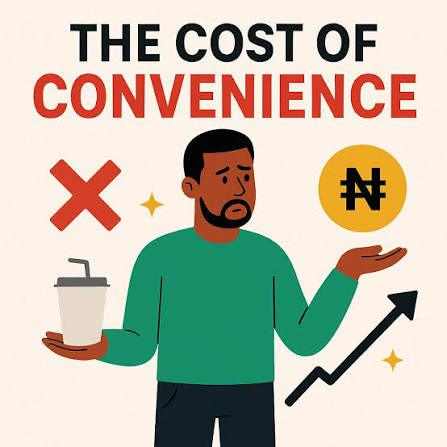
The Hidden Cost of Convenience refers to the expense that people incur from products or services that save them time, energy, or effort. It is quite straightforward. A meal is delivered to their doorstep. Their purchase arrives the following day. A subscription provides constant access to content. Tapping a button substitutes physical travel or any other effort. However, there is more to these small benefits that people enjoy in their lives.
This is the essence of The Hidden Cost of Convenience. What seems so simple initially ends up involving further expenses, wastes, lack of privacy, and lack of control of people’s habits. There is no need to see that cost on the receipt. It might become visible in bank accountsexpenses;s, in data records, and in peoples’ behavior. This explains why this issue is so relevant nowadays. Convenience has been incorporated in all spheres of life, including shopping, transportation, food, media, and work.
What convenience really means
ConveA subscriptions to ease of use, availability, or accessibility. This trait helps save time, reduces effort, and eliminates any type of friction. That is why convenience is such an attractive thing. In most cases, people are too busy, too tired, and have a lot of stress in their lives. In cases where something faster is available, people usually choose it. But convenience changes behavior. Once people get used to convenient things, they will stop comparing alternatives, willpeople’s behaviour.nd of advance planning, and will stop doing anything themselves. Convenience could save money for some time but could be expensive in long-term.

This is when the problem of The Hidden Cost of Convenience appears. The matter is not in convenience itself but in paying for it without understanding the final price.
Financial costs
One of the most apparent costs is financial. A number of conveniences appear inexpensive initially; however, when the cost of additional fees, payments, tips, etc., is taken into account, their cost increases significantly. Take food delivery services. In this case, an inexpensive lunch in the application turns out to be significantly more expensive than cooking dinner oneself or going to the place of delivery.
Another issue is the danger of subscriptions. One may think that paying the monthly fee is not such a large sum. However, in practice, many individuals subscribe to various services simultaneously, using only a couple of them. Moreover, this problem applies to applications whose free trial ends up as paying ones. In addition, buy now pay later is also a convenient option to spend money easily.
It is not surprising that The Hidden Cost of Convenience article is often related to personal finance sphere. Here, the issue lies in the fact that a single purchase does not lead to trouble. The matter is in the regularity of purchases that are easy to make. These purchases are difficult to notice due to their small cost; nevertheless, they can influence one’s budget seriously.
Environmental costs
Moreover, convenience entails high costs from the perspective of the environment. A number of convenient solutions require more packaging, transportation, use of energy and produce more waste. Cups for one-time use, takeaway containers, cutlery made of plastics, fast fashion and speedy deliveries are associated with the creation of waste.
The concept of fast fashion provides another example of this issue. Clothing made cheaply and quickly available becomes easy to purchase and replace. In such a way, fast fashion leads to excessive production and waste. Moreover, many pieces of clothing are used several times before they are thrown away. The same situation can be observed in regard to home delivery and online shopping. Everything extra, including boxes, wrapping, additional labels and even courier delivery, causes environmental problems.
The Invisible Cost of Convenience is not visible in this case because of distribution of the negative effects. It may not look much if an individual orders one parcel or buys one takeaway meal in one bag. However, millions of people make similar choices daily. Thus, their environmental cost is rather high.
Data and privacy costs
However, there is another sort of price associated with the convenience of the digital environment. There are many apps, services, and platforms that are either free of charge or have very low prices because the user is not the actual commodity in this exchange data is.
This bargain is not always visible because the convenience of an application or a platform can easily be mistaken for its usefulness. For example, fast loading time and a seemingly harmless free account are often a price that users pay for their private data, including browsing behaviour, location, clicks, purchases, contacts, and search history.
Convenience Price in Digital Environment does not refer only to privacy settings. It is about dependence too. If everything from sending messages to payments, storage, shopping, and entertainment is done through one service, it is difficult to go away.
Mental and social costs
Convenience can influence people’s perception in general too. If one’s life becomes too convenient, it may be harder to develop patience, as waiting takes effort. One can expect immediate gratification from eating, watching movies, purchasing, and communicating. This, in its turn, can make one impatient and develop a habit of reacting immediately.
Moreover, it can influence the process of decision-making. Convenient access always comes along with impulse buying. All one needs to do is to see the object in question and tap once to purchase it. There is no time to reflect on whether it is really needed or not. The same process takes place while ordering meals, using streaming and social media apps.
It should be mentioned that convenience can have a social aspect too. As more actions are being performed by apps, people may lose some basic skills or routines. They become less likely to cook, repair, plan something or create manually. It saves time, but may take away one’s sense of control. The Hidden Cost of Convenience, in this context, refers to both the money people spend and their lost actions.
Why it keeps growing
Convenience works because it suits the modern world. Everyone is busy. Cities are bustling. Work consumes a lot of time. Commuting consumes time too. People are around screens all the time. In such an environment, the easy options will continue to capture people’s interest. Companies will emphasize convenience because it ensures that people remain active and spend money. It creates a culture where speed is rewarded.
There is also a psychological aspect to it. People tend to concentrate on the immediate. Eating a quick meal makes sense right now. A risk to data security and even the potential bills in the future can easily be forgotten. Such differences help make it easy to disregard the total costs involved. It is one reason why the hidden cost of convenience keeps increasing.
How to manage it?
It isn’t necessary to eliminate convenience entirely. This is impossible. Instead, it is wise to apply it in a responsible way. The following small things can assist in achieving that goal:
- Consider the full price when you choose convenience.
- Go through your subscription list each month.
- Do batch cooking, shopping, and travelling whenever you can.
- Use delivery services only if it helps you save time and energy.
- Check your app privacy settings.
Consider whether your purchase solves a problem or just saves you some time.
These small things won’t eliminate convenience at all. These will just help you make it more intentional, which is the point. The main idea is that your choice should work for you, not against you.
A better way to think about it
The Hidden Cost of Convenience is not an alarm call against the march of progress. It is an encouragement to look beyond the superficial. Something being easy does not mean that it comes without any expense. Something being fast does not make it any better. Something being free does not make it harmless. Once people get to know the real cost, they can make an informed decision.
This change in perspective is not only relevant to our daily routine but also relevant for the world of businesses, technology, and policy making. Businesses produce technology for reducing friction. This is often a good thing and, in some cases, a necessity. Nevertheless, the consumers still have to question what they are trading for the luxury of convenience. If it is money, privacy, time, and health, then perhaps the convenient option is not such a bargain anymore.
After all, the purpose of The Hidden Cost of Convenience is awareness. Convenience is here to stay. The challenge is to pay attention to the hidden price tag before making a purchase.