The global telecommunications landscape operates on a single, uncompromising metric: continuous, high-quality network coverage. For decades, mobile network operators poured hundreds of billions of dollars into erecting massive macro cell towers, deployment of microcells, and expanding radio access networks (RAN). Yet, despite these massive physical buildouts, traditional radio waves frequently run into an unyielding physical wall. High-frequency signals from 4G LTE and 5G networks struggle to penetrate modern construction materials like reinforced concrete, low-emissivity glass, and subterranean steel beams. This structural limitation often leaves users with dropped connections and zero bars of coverage deep inside corporate offices, residential basements, and high-density apartments.
To bypass these physical barriers without building thousands of expensive new cell towers, the telecom industry engineered a highly innovative software workaround. Understanding how Wi-Fi calling works reveals a brilliant, hardware-rooted architecture that seamlessly turns any local wireless router into a secure, functional extension of a cellular network. By utilizing advanced Internet Protocol (IP) routing, secure cryptographic tunneling, and carrier-grade identity verification, this technology allows mobile devices to bypass local cell towers entirely, smoothly routing crystal-clear voice calls and SMS text messages across the global internet.
1. The Core Architecture: The Evolved Packet Data Gateway (ePDG)
When you make a standard call using a traditional cellular connection, your phone transmits a direct radio signal to a nearby cell tower. The tower routes that traffic straight into the carrier’s highly secure, private core network. However, when your device switches to a local home or coffee shop wireless network, your data must travel over an “untrusted” network the public internet.
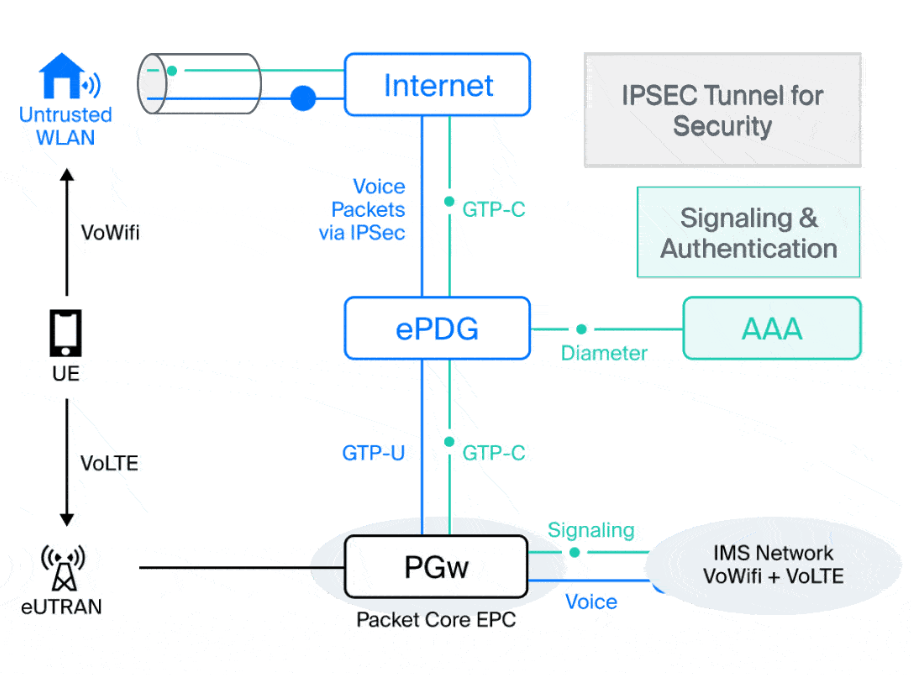
To bridge this trust gap safely, the Third Generation Partnership Project (3GPP) standardized a vital architectural element known as the Evolved Packet Data Gateway (ePDG). The ePDG acts as a highly secure, enterprise-grade gatekeeper standing at the absolute edge of the carrier’s private network core. Every time your smartphone activates its wireless calling features, it automatically runs a background Domain Name System (DNS) query to locate its specific carrier’s ePDG endpoint. Once the phone locates this gateway, it negotiates a secure, end-to-end cryptographic connection across the internet using Internet Key Exchange version 2 (IKEv2).
This negotiation creates a tightly sealed IPSec (Internet Protocol Security) tunnel that encapsulates all voice data. Because this cryptographic wall terminates directly inside the carrier’s private core, the local wireless router and the public internet provider see nothing but unreadable, encrypted UDP packets, keeping your conversation completely safe from local snooping or interception.
2. Cryptographic Identity Verification: SIM-Based Authentication
A primary reason why how Wi-Fi calling works is so seamless for the end user is that it completely avoids the need for manual passwords, user profiles, or third-party application log-ins. Instead, the system reuses the exact same hardware-rooted security layer that protects your device when it connects to a physical cell tower: your Subscriber Identity Module (SIM) card.
| Network Security Domain | Untrusted IP Network (Local Wi-Fi Hub) | Carrier Private Network Core |
| Initial Request Phase | Smartphone connects to local router and requests access. | AAA Server receives request and pulls the profile data. |
| The Challenge Phase | Device intercepts the carrier challenge and routes it to the SIM. | Core network issues an encrypted, randomized EAP-AKA challenge. |
| Cryptographic Solution | SIM uses its factory-baked secret key (Ki) to solve the puzzle. | Authentications hub waits for matching mathematical output. |
| Access Authorization | Smartphone returns the unique verification signature. | Validates signature, opens the IPSec tunnel, and grants network access. |
To establish a trusted connection over an unmanaged public network, the ePDG communicates directly with a 3GPP-compliant Authentication, Authorization, and Accounting (AAA) Server. The gateway initiates verification using a specialized protocol known as EAP-AKA (Extensible Authentication Protocol-Authentication and Key Agreement).
During this verification loop, the carrier’s core network issues a unique, randomized mathematical challenge to the smartphone. The phone forwards this challenge directly to the secure enclave of the physical or digital eSIM card.
The SIM card uses its factory-baked secret key (Ki) to solve the mathematical puzzle, returning a unique cryptographic signature back to the carrier. Because the secret key itself is never transmitted over the air or across the internet, the network can instantly verify your phone number and billing profile with carrier-grade security, allowing your device to register with the network automatically.
3. Session Initiation and the IMS Core Network
Once the secure IPSec tunnel is fully established and authenticated, your smartphone functions exactly like a localized, virtual cell tower. To place or receive calls, the device registers with the carrier’s absolute brain: the IP Multimedia Subsystem (IMS) Core.
Protocol Alignment Profiles Within Voice Architectures
| Network Control Layer | Cellular Connection (VoLTE/5G) | Wi-Fi Connection (VoWiFi) | Functional Software Assignment |
| Primary Access Medium | Dedicated Licensed RAN (Cell Towers) | Unlicensed 802.11 Wireless Spectrum | Manages raw physical radio transmission |
| Transport Layer Tunnel | GPRS Tunneling Protocol (GTP) | IPSec Cryptographic Tunnel (SWu) | Encapsulates payload traffic safely |
| Session Control Layer | Native SIP over IMS Registration | Native SIP over IPSec Tunnel | Manages call dialing, ringing, and teardown |
| Audio Media Stream | Real-Time Transport Protocol (RTP) | Encrypted RTP (SRTP in UDP) | Delivers active, real-time voice data |
The phone utilizes the Session Initiation Protocol (SIP) to communicate through the encrypted tunnel, sending a digital message to register its current temporary IP address with the IMS core. When you dial a phone number, a SIP “INVITE” message travels straight through the internet, hits the ePDG, and enters the carrier’s softswitch infrastructure.
From that point forward, your audio data is converted into compressed, high-definition voice packets using the Real-Time Transport Protocol (RTP). Because the internal IMS core handles a Wi-Fi call identically to a standard VoLTE or 5G connection, you can use your phone’s native dialer, access your integrated contact book, and text friends without noticing any platform difference.
4. Seamless Session Continuity: Handover Performance Mechanics
The most impressive aspect of how Wi-Fi calling works is its ability to handle live handovers between wireless routers and physical cell towers without dropping your call. This smooth transition relies on an infrastructure optimization technique called session anchoring.
| Handover Variable / Parameter | Wi-Fi Signal Dominated Zone (VoWiFi) | Cellular Signal Dominated Zone (VoLTE/5G) |
| Core Session Anchor | Fixed permanently at the Packet Data Network Gateway (PGW). | Fixed permanently at the Packet Data Network Gateway (PGW). |
| Primary Signal Metric | Active wireless signal remains strong (Greater than 85dBm RSSI). | Wireless signal drops past critical thresholds (Less than 85dBm RSSI). |
| Data Delivery Pipeline | Routes via the secure ePDG internet tunnel (SWu interface). | Routes via the dedicated, licensed Radio Access Network (Cell Tower). |
| Transition Execution Time | Active baseline tracking mode. | Swaps data pathways in under 30 milliseconds without dropping audio. |
When you start a call on your home wireless network, your active voice session is permanently anchored at a central core router known as the Packet Data Network Gateway (PGW). As you walk out your front door and move down the street, your phone’s operating system continuously monitors its Received Signal Strength Indicator (RSSI).
If your wireless router signal drops below a critical threshold (typically 85dBm), the smartphone initiates a fast backup connection to a nearby 4G or 5G cell tower. The device tells the cell tower to contact the anchored session on the central PGW.
Because the PGW keeps the core session constant, it simply swaps the underlying data delivery pathway from the ePDG internet tunnel over to the cellular radio tower. This entire routing switch happens in under 30 milliseconds a window so fast that the human ear cannot detect a single frame of missing audio.
5. Network Quality of Service (QoS) Challenges
While understanding how Wi-Fi calling works highlights an exceptionally robust network design, its real-world audio quality remains heavily dependent on the performance of the local network. Unlike cellular towers, which use dedicated, licensed radio frequencies, wireless routers operate on open, shared civilian airwaves. If multiple devices on a home network are aggressively downloading large files, streaming ultra-high-definition video, or running intensive cloud backups, raw voice packets can easily get trapped in local buffer queues. This delay triggers severe jitter and packet loss, resulting in choppy audio or unnatural gaps in conversation.
To solve this latency bottleneck, modern enterprise routers implement Wi-Fi Multimedia (WMM) standards. WMM reads incoming data tags and automatically places sensitive voice traffic into the highest-priority access tier (AC_VO). By clearing a dedicated path for voice data ahead of standard web traffic, the router ensures your conversation stays clear and stable, even on a highly congested network.
The Definitive Standard for Modern Mobile Connectivity
The rapid transformation of global communications proves that a modern mobile subscription is no longer bound to the physical reach of a cellular tower. By turning the open architecture of the internet into a secure, carrier-grade transport layer, wireless calling has transformed from a simple backup feature into an essential pillar of everyday network design.
By shifting the root of network connectivity away from vulnerable external signals and anchoring it securely within local hardware routers, this technology provides a complete solution for indoor coverage challenges. As mobile providers standardize automated handovers across global data networks and devices connect natively to local access points, the mechanics of how Wi-Fi calling works will continue to deliver reliable, high-definition communication, ensuring you stay smoothly connected no matter how thick the concrete walls around you are.