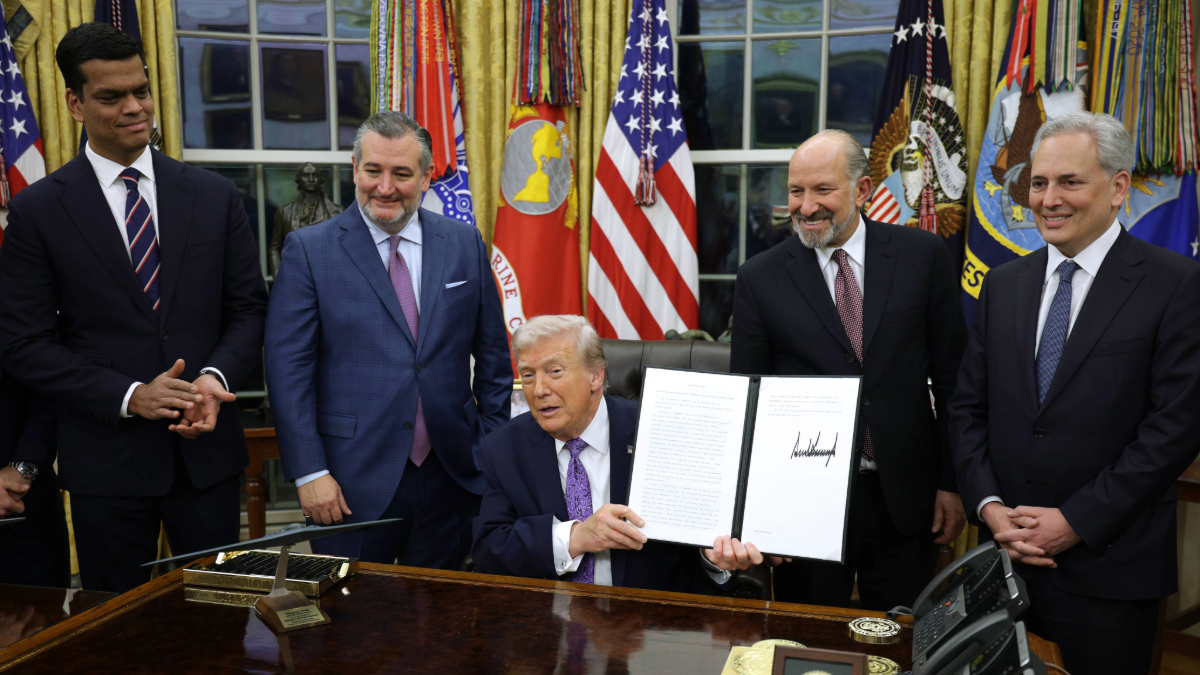
In a surprise move, President Trump signed a daring executive order on Thursday that has the potential to redefine the future of artificial intelligence within the United States. The order focuses on state regulations regarding AI, giving the federal government broad authority to negate regulations that have been laboriously set by a significant number of states.
The order gives sweeping power to the attorney general to sue states and invalidate laws that are considered to be violative of the position of the United States as a leader in AI globally. The states that might refuse to change could suffer heavily, as the government has plans to withdraw funds meant for use in broadband infrastructure.
This is a huge win for the tech industry, which has been strongly resisting the proliferation of state-by-state regulations on AI. The president’s logic is simple: it is necessary for America to speak with one voice in order to remain on top of the AI race against China, but with 50 states having different regulations, it is far too confusing for the industry.
“It has to come from one source,” Trump told the media on the occasion of the signing ceremony in the Oval Office, with David Sacks, his AI & crypto Czar, beside him. “You can’t go to 50 different sources.”
Trump Administration’s AI Deregulation Sparks Bipartisan Backlash and Legal Challenges Over State vs. Federal Authority
The government’s tough line on regulating AI is part of the overall support that Trump has shown to the technology sector. He has signed a number of executive orders that are aimed at minimizing regulations, making government data available to AI startups, and facilitating the development of infrastructure that is essential when developing AI systems.
Even this week, Trump has eased regulations on the use of exported AI chips. Sacks is a notable figure who is simultaneously a Silicon Valley investor.
This has, however, prompted an instant reaction from all quarters of the political divide. Already, lawyers are prognosticating challenges to the law from state governments and consumer protection organizations, who are claiming that only Congress has the power to invalidate state statutes under the Constitution. The relationship between the state and the national government is set to become a significant arena for a potential legal struggle.
Critics warn that the removal of state safeguards without providing adequate safeguards at the national level would expose Americans to danger. “Taking away state laws before providing commensurate national protections is merely a favor bestowed on Big Tech giants,” said Wes Hodges of the Heritage Foundation, a conservative think tank.
The potential is high because the available generative AI technology, which has the potential to produce authentic texts, voices, videos, and images, has suddenly gone viral with serious apprehensions following suit. Such technologies are known to mislead consumers, with reports of conversation robots dispensing life-threatening advice to minors.
The states responded because there has been a lack of government oversight on this matter. This year, all states introduced bills pertaining to AI, with 38 states that enacted a hundred laws that cover different AI issues.
States Set Safety Standards as Critics Warn of Onerous Laws and Ideological Bias
California has set the bar high by making the most advanced models of AI, such as ChatGPT and Google’s Gemini, conduct safety tests on their systems with publicly available results. South Dakota prohibited deepfakes in political campaign videos close to election dates.
The states of Utah, Illinois, and Nevada set regulations on AI-powered chatbots assisted with mental health, making it a requirement to inform consumers that they are interacting withbots, not humans, with a set limit on how they can collect consumer information.
“We are going to zero in on what we believe are the most onerous state laws, especially those which could inject ideological bias into AI,” Sacks said during the signing ceremony.
Although the Thursday executive order states that it doesn’t preemption current child safety statutes, it never specified what this exactly means. Most states have now established regulations aimed at the ban of AI-powered chatbots, as well as social media websites that use such technologies for minors.
“State laws on AI are a nightmare that is simply not acceptable to parents and people concerned with safeguarding kids on the internet,” said Sarah Gardner, head of Heat Initiative, a child protection agency. “State laws are essentially the only line that has protected kids from AI.”
Congressional Moratorium Defeated, Court Challenges Ahead
The trade association’s lobbying campaign has been vigorous. In fact, some members of Congress attempted to add a state moratorium on AI laws lasting ten years to a domestic policy bill earlier in the year, but bipartisan opposition defeated that amendment.
The position of Silicon Valley has been articulated by venture capital investor Marc Andreessen, who wrote last month that “state-by-state regulations are a startup killer.”
The coming weeks and months are sure to see challenges to this order in courts throughout the country, which promises a conflict at the root level between authority, state sovereignty, and the future of AI regulation in the United States.