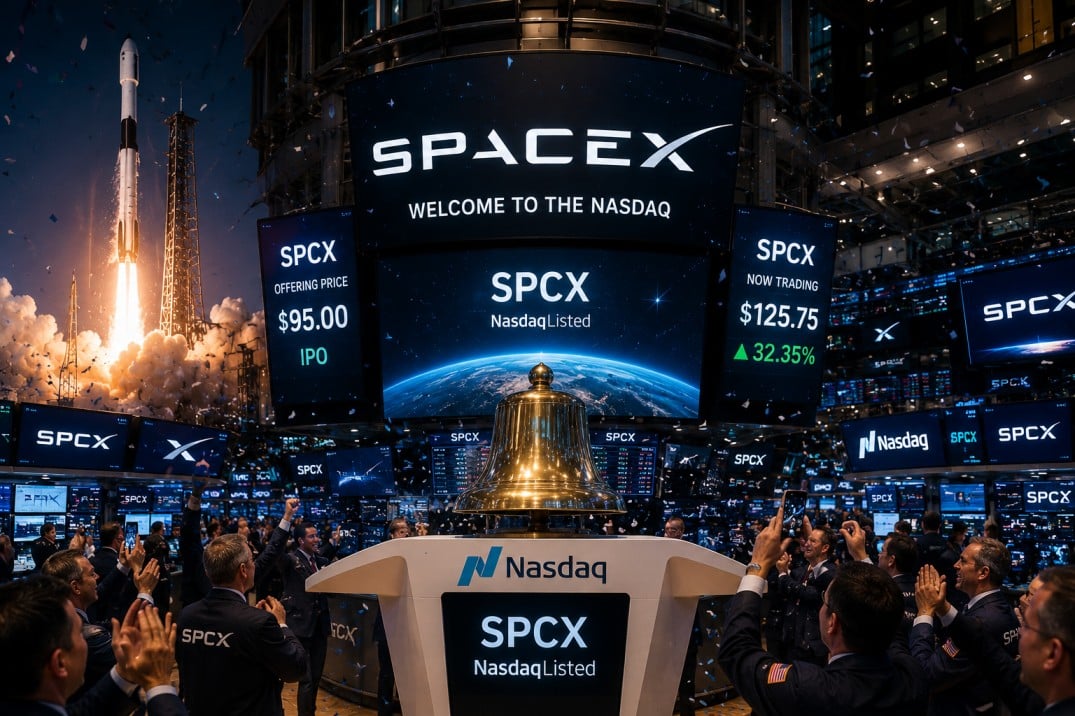
SpaceX is preparing to make one of the most closely watched stock market debuts in recent history, with investor demand reaching levels rarely seen in public markets and early indications suggesting the shares could open well above their offering price.
The aerospace and satellite communications company, led by Elon Musk, is expected to begin trading on the Nasdaq under the ticker SPCX after completing a record-breaking initial public offering that valued the business at roughly $1.77 trillion. Before trading had even begun, reports indicated that investor interest had already far exceeded the number of shares available, creating intense focus on how the stock might behave once public trading starts.
The listing marks a turning point not only for SpaceX but also for investors who have spent years searching for ways to gain exposure to a company that remained private while becoming one of the most influential names in the space industry. For much of its existence, ownership was largely limited to employees, venture capital firms, institutional investors and a small group of wealthy individuals. Public market investors watched from the sidelines as the company built reusable rockets, expanded Starlink and entered artificial intelligence through acquisitions and investments linked to Musk’s wider business interests.
Now that barrier has been removed, at least in part. Yet the excitement surrounding the offering raises a broader question about how investors are valuing one of the world’s most talked-about companies and whether enthusiasm is running ahead of financial reality.
Demand Surges as SpaceX Enters Public Markets
The numbers surrounding the flotation have drawn attention across Wall Street. Reports suggest investor orders reached hundreds of billions of dollars, far exceeding the amount of stock available in the offering. Retail participation has also been unusually strong, with brokers reporting substantial interest from individual investors hoping to secure shares before trading begins.
That demand reflects more than interest in a single company. It also highlights the appeal of businesses that have spent years building a reputation in private markets before eventually seeking a public listing. SpaceX arrives with a level of name recognition that few newly listed companies possess.
The company has become closely associated with reusable rocket technology, satellite internet services and ambitious long-term plans involving space exploration. Those activities have generated public attention for years, creating a situation where investors are already familiar with the company long before its first day as a publicly traded business.
Early market indications suggested shares could begin trading substantially above the IPO price of $135. Such a move would immediately add hundreds of billions of dollars to the company’s market value and further strengthen Musk’s position among the world’s wealthiest individuals.
The offering also creates wealth for existing shareholders. Thousands of current and former employees hold stock that may now be worth far more than when it was originally granted. Several executives and early investors stand to see large increases in the value of their holdings if trading remains strong.
Yet behind the excitement lies a more complicated picture. Public investors are buying into a company that remains heavily influenced by its founder. Musk retains overwhelming voting control, giving him authority over major decisions even after the company enters public markets. Some governance specialists have questioned whether ordinary shareholders will have enough influence over future decisions.
Those concerns have attracted attention from politicians and market observers who argue that investors should carefully understand the voting structure before purchasing shares. The debate highlights a broader trend in technology listings, where founders often retain substantial control long after companies become publicly traded.
Valuation Debate Intensifies as Investors Weigh Growth Against Risks
The enthusiasm surrounding SpaceX has not eliminated questions about valuation. Several analysts have argued that the company’s market value assumes years of rapid revenue growth across multiple businesses.
SpaceX has presented itself as more than a rocket company. Starlink has become a major source of revenue through broadband services, while artificial intelligence projects and other technology initiatives have expanded the company’s ambitions into new areas. Supporters argue that these businesses provide opportunities that justify a premium valuation.
Critics see the situation differently. Some analysts have pointed to a gap between current financial results and the valuation implied by the IPO price. Questions have been raised about future profitability, spending levels and the assumptions required to support a market capitalisation approaching $2 trillion.
Financial disclosures released ahead of the IPO showed that not all parts of the company are profitable. Starlink remains the strongest contributor to earnings, while other divisions continue to consume substantial amounts of capital. Investment spending has risen sharply as the company pursues projects ranging from space systems to artificial intelligence.
For investors, this creates a familiar dilemma. The company operates in industries with large opportunities, but those opportunities still need to translate into sustained earnings growth. Public markets will now evaluate those results quarter by quarter rather than relying on private funding rounds and periodic valuation updates.
Another source of debate involves the relationship between SpaceX and Musk’s wider group of companies. Existing business links with Tesla and other Musk-controlled entities have prompted questions about future transactions between related firms. Supporters view those connections as useful links between companies working on similar technologies. Critics argue that such arrangements can make it harder for investors to assess financial performance independently.
The stock market debut also arrives during a period when investor appetite for high-growth technology businesses remains strong. Several recent listings have attracted heavy demand despite concerns about valuation, suggesting many investors remain willing to pay premium prices for companies viewed as leaders in emerging industries