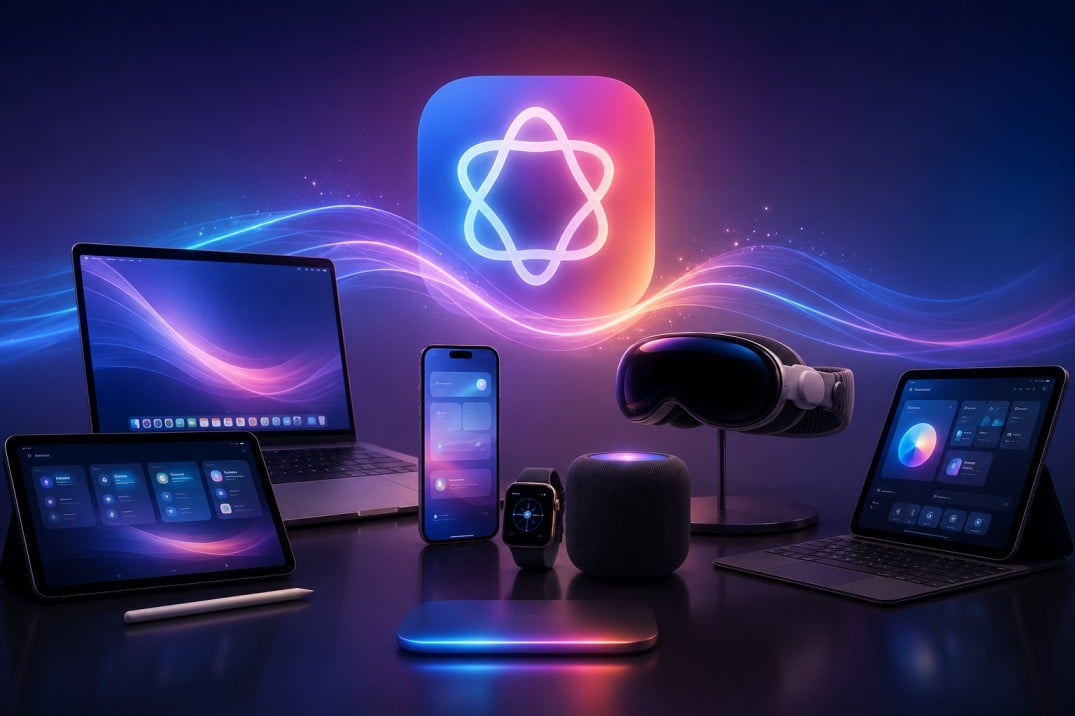
Apple used its annual Worldwide Developers Conference to make a clear statement about where it believes personal technology is heading. Artificial intelligence sat at the centre of nearly every major announcement, from a rebuilt Siri and smarter apps to photo editing tools and system-wide automation. Yet the event carried another layer of importance. It marked the final WWDC keynote led by Tim Cook before he hands over leadership of the company later this year.
Held at Apple Park in Cupertino, the conference offered a detailed look at software updates coming to the iPhone, iPad, Mac, Apple Watch and Vision Pro. While Apple has spent the past two years facing questions about its place in the AI race, this year’s presentation suggested the company is attempting to move from catching up to carving out its own approach.
Rather than focusing solely on large language models or chatbot-style products, Apple framed its latest effort around making devices more useful in everyday situations. Whether that approach will satisfy investors and developers remains an open question, but the company made clear that artificial intelligence is no longer a side project. It is now woven into nearly every part of Apple’s software strategy.
Siri Steps Into a New Role as Apple Deepens Its AI Push
The biggest announcement of the event was the arrival of what Apple calls Siri AI, a rebuilt version of the voice assistant that has struggled for years to keep pace with rivals.
For more than a decade, Siri served as one of the most recognisable features on Apple devices. Yet as AI systems became more conversational and capable, Apple’s assistant increasingly appeared limited by comparison. Monday’s presentation was Apple’s attempt to change that perception.
The new Siri is no longer positioned as a simple voice command system. Instead, Apple wants it to function as a conversational assistant capable of understanding context, handling follow-up requests and working across applications. Users can interact with Siri through voice or text and continue conversations over time rather than starting from scratch with each request.
Apple demonstrated scenarios in which Siri could analyse information displayed on a screen, gather details from apps, create reminders and perform tasks across different services. The company also introduced a dedicated Siri application that allows users to revisit previous conversations and continue interactions across devices.
Much of this capability relies on a combination of Apple’s own foundation models and technology developed through its partnership with Google. Apple confirmed that its latest AI architecture incorporates Google’s Gemini models for certain advanced tasks, marking one of the most important partnerships in the company’s recent history.
Executives repeatedly argued that Apple’s approach differs from competitors because it places personal information at the centre of the experience. During the presentation, software chief Craig Federighi suggested that some technology companies are pursuing artificial intelligence without paying enough attention to how people actually use it. Apple’s answer, he said, is an assistant that understands personal context and device activity while maintaining privacy controls.
The company also introduced new AI functions across many of its applications. Safari can now organise tabs into topics automatically and monitor webpages for updates. Messages and Calendar can identify tasks hidden within conversations and suggest actions. The Passwords application is gaining the ability to automatically update compromised credentials on supported websites.
Photo editing received one of the largest upgrades. Apple unveiled tools that can extend image backgrounds, adjust composition and alter perspectives after a photo has been taken. The company stressed that these additions are intended to improve photographs rather than replace them, though they move Apple closer to techniques already being adopted elsewhere in the industry.
A Farewell Stage for Cook as Apple Balances Ambition and Restraint
The conference was not solely about software. It also served as a symbolic moment for a company approaching a leadership change.
Cook, who became chief executive in 2011 following Steve Jobs, will step down in September and move into a new role as executive chairman. His successor, John Ternus, is expected to take control during a period when Apple faces increasing pressure to prove its AI plans can generate the same excitement that previous product categories once delivered.
Cook kept his personal remarks brief but emotional. Closing the keynote, he thanked developers and reflected on the role they have played during his years leading the company. He described helping people connect, learn and create as one of the defining goals of his tenure.
The timing of the transition adds weight to Apple’s AI strategy. For much of Cook’s leadership, the company built its reputation around hardware products such as the iPhone, Apple Watch and AirPods. The next phase may depend more heavily on software intelligence and how effectively Apple can make artificial intelligence useful across its product family.
Outside Siri, Apple announced a range of software refinements. The next version of macOS will be called Golden Gate, continuing the company’s tradition of naming operating systems after California locations. Apple also revised its Liquid Glass interface, introduced last year, after receiving criticism from some users. A new adjustment slider allows people to control transparency levels and improve readability.
Performance improvements featured prominently throughout the presentation. Apple said apps will launch faster, search functions have been rebuilt and older devices will continue receiving support. iOS 27 will run on iPhone models dating back to the iPhone 11, giving the update one of the broadest compatibility ranges in the company’s history.
Privacy and child safety also received attention. Parents will gain new controls over web browsing, messaging and app access for children. Apple said younger users will face stronger protections by default, while adults can gradually expand permissions as children grow older.
Not every user will receive the latest AI features immediately. Apple confirmed that Siri AI will initially launch only in English and will not be available in the European Union or China at release. Company executives cited regulatory requirements as the main reason for the delay.
That limitation portrays a challenge facing technology companies as artificial intelligence becomes more deeply connected to personal data and online services. Building powerful software is only one part of the task. Companies must also navigate a growing patchwork of laws governing privacy, competition and data use.
By the end of the keynote, Apple had presented a vision centred on smarter software rather than entirely new devices. Whether that proves enough to satisfy investors looking for the company’s next major growth story remains uncertain. What was clear, however, is that Apple’s AI strategy is no longer waiting in the wings.
For Tim Cook, the event marked the closing of a chapter that began nearly 15 years ago. For Apple, it marked the beginning of a period in which artificial intelligence will increasingly shape how its products work, how users interact with them and how the company defines itself in the years ahead.