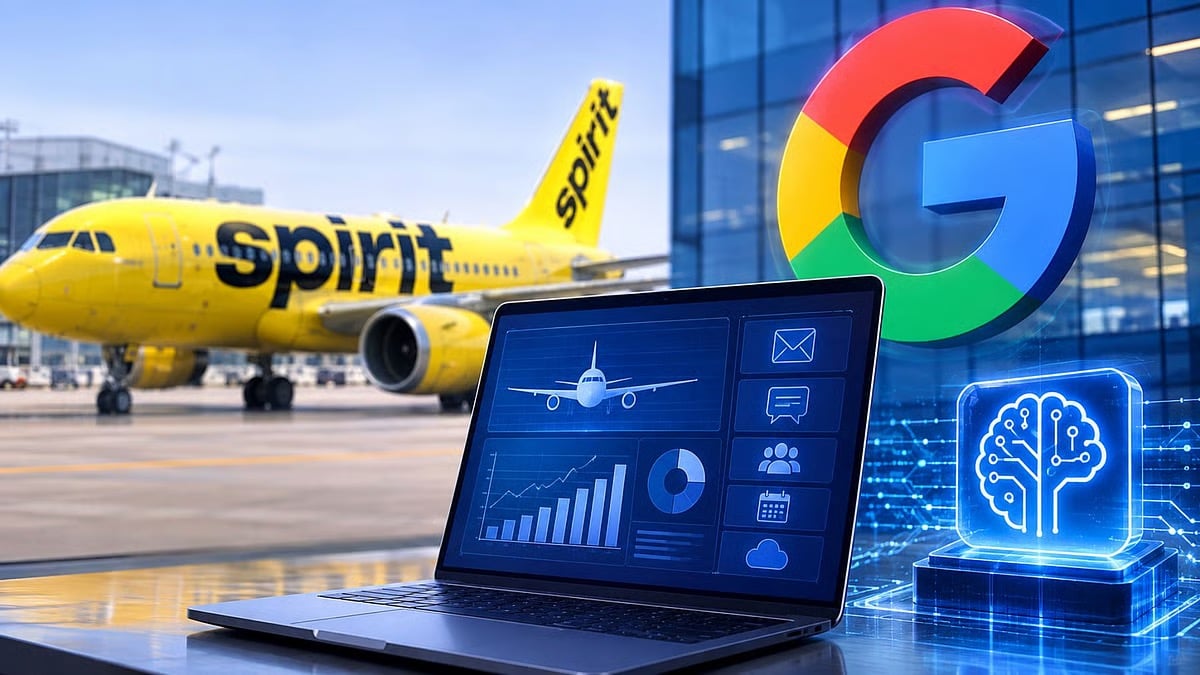
Google is reportedly paying $10 million for a massive collection of internal data from Spirit Airlines, including approximately 100 million emails and 500 million Microsoft Teams messages, as the technology giant looks to expand the data available for training and developing artificial intelligence systems.
The transaction is emerging from Spirit Airlines’ bankruptcy proceedings and highlights the rapidly increasing value of corporate data in the AI industry. The deal would give Google access to an enormous archive of workplace communications and other business information generated by employees during the airline’s operations.
The data is expected to be transferred to Google only after personally identifiable information has been removed by an independent third party. The arrangement is intended to address privacy concerns surrounding the transfer of employee communications and other sensitive corporate information.
Google’s purchase demonstrates how AI companies are increasingly looking beyond publicly available information for datasets that can help them build more capable models and products.
A Huge Collection of Workplace Communications
The size of the Spirit dataset is one of the most striking aspects of the transaction.
The collection reportedly contains around 100 million emails and 500 million Microsoft Teams messages. It also includes other digital records created during Spirit’s operations, potentially providing Google with a detailed picture of how a large airline functioned internally.
Workplace emails and chat messages can contain information about everything from project management and customer service to marketing, technology, operations and employee collaboration.
For an AI developer, such information can be valuable because it reflects how people communicate and solve problems in real business environments.
AI systems are increasingly being developed to perform tasks that traditionally required human workers, including writing emails, organizing information, analyzing documents, assisting with customer service and coordinating business operations.
Large collections of authentic workplace communications could help developers understand these activities in greater depth.

Why Google Is Interested
Google has invested heavily in artificial intelligence through its Gemini family of AI products and other machine-learning technologies. The company competes with some of the world’s largest technology companies in the race to develop increasingly capable AI systems.
Training advanced AI models requires enormous amounts of data. Historically, much of that information has come from books, websites, public documents and other material available online.
However, companies are increasingly searching for high-quality private or proprietary datasets that offer information that cannot easily be obtained from the public internet.
Spirit’s internal records could provide exactly that type of material.
The airline’s communications cover a complicated business environment involving thousands of employees and a wide range of functions. The dataset could potentially help AI systems learn about workplace communication, business processes and decision-making in ways that conventional web data cannot.
Google has not publicly provided extensive details about exactly how the Spirit data will be incorporated into its AI systems. However, the transaction is expected to support AI development and product-related work.
Privacy Protections
The acquisition has inevitably raised concerns because emails and workplace chat messages can contain sensitive information about employees and business activities.
To address those concerns, a third party will reportedly remove personally identifiable information from the dataset before it is transferred to Google.
This process is intended to prevent information such as names and other identifying details from being directly associated with individuals when the data reaches Google.
The privacy protections are particularly significant because the dataset is enormous. With hundreds of millions of messages involved, even a small amount of sensitive information could potentially affect a large number of people.
The deal also raises broader questions about the ownership and future use of workplace communications.
Employees may create emails and Teams messages for business purposes without expecting those communications to eventually become part of an AI training dataset. However, corporate records can become valuable assets when a company restructures, is sold or enters bankruptcy.
Spirit’s bankruptcy proceedings have effectively turned its digital information into another category of asset that can be monetized.
Spirit’s Digital Archive Becomes Valuable
Spirit Airlines’ financial troubles created an opportunity for companies to acquire assets associated with the airline. While aircraft, airport operations and other physical assets may attract traditional buyers, its digital records have attracted interest from technology companies.
The reported $10 million price demonstrates that corporate data can have substantial value even after the company that generated it is no longer operating normally.
The potential value comes from the scale and diversity of the information. A dataset containing hundreds of millions of workplace interactions can offer an AI developer an unusually large collection of examples of human communication and organizational behavior.
The deal could also encourage other companies to reconsider the value of their own archives.
As AI development accelerates, corporate databases, communications and documents could increasingly become valuable assets in mergers, acquisitions and bankruptcy proceedings.
A Growing Data Race
Google’s reported purchase comes amid an increasingly competitive race among technology companies to obtain data for AI development.
Companies developing large language models are looking for datasets that are large, diverse and useful. At the same time, concerns about copyright, privacy and the quality of publicly available information have made proprietary datasets more attractive.
Enterprise data offers a different opportunity.
Instead of simply learning from publicly available articles or websites, AI systems could potentially learn from examples of how employees communicate, plan projects, manage problems and collaborate.
This could be particularly useful for developing AI assistants designed for businesses.
However, the use of workplace data also creates difficult questions about privacy, consent and responsible AI development. Removing personally identifiable information can reduce privacy risks, but it does not necessarily eliminate every concern associated with using corporate communications.
The Spirit transaction could therefore become an important example of how companies balance the commercial value of data with the rights and expectations of the people who generated it.

What the Deal Could Mean for the AI Industry
Google’s $10 million purchase signals that data is becoming an increasingly valuable component of the AI economy.
The transaction shows that the information generated inside ordinary businesses can have a second life as a resource for artificial intelligence development. Emails, workplace chats and other corporate records may no longer be viewed solely as historical archives or operational documents.
Instead, they can become valuable datasets capable of attracting millions of dollars from technology companies.
For Google, the Spirit Airlines data represents an opportunity to gain access to an enormous collection of real-world workplace communications. For the broader AI industry, it could signal the beginning of a larger market for corporate data.
As AI companies continue searching for better training material, bankrupt businesses and their digital archives may become increasingly attractive targets.
The Spirit deal ultimately illustrates a fundamental shift in the technology industry: data generated through everyday business operations is becoming an increasingly valuable asset in the race to build the next generation of artificial intelligence.