Artificial Intelligence has moved far beyond simple question-and-answer systems. Over the last few years, businesses and consumers have become familiar with AI-powered chatbots that can answer queries, provide support, and automate routine conversations. However, a new category of AI technology is rapidly gaining attention: AI agents.
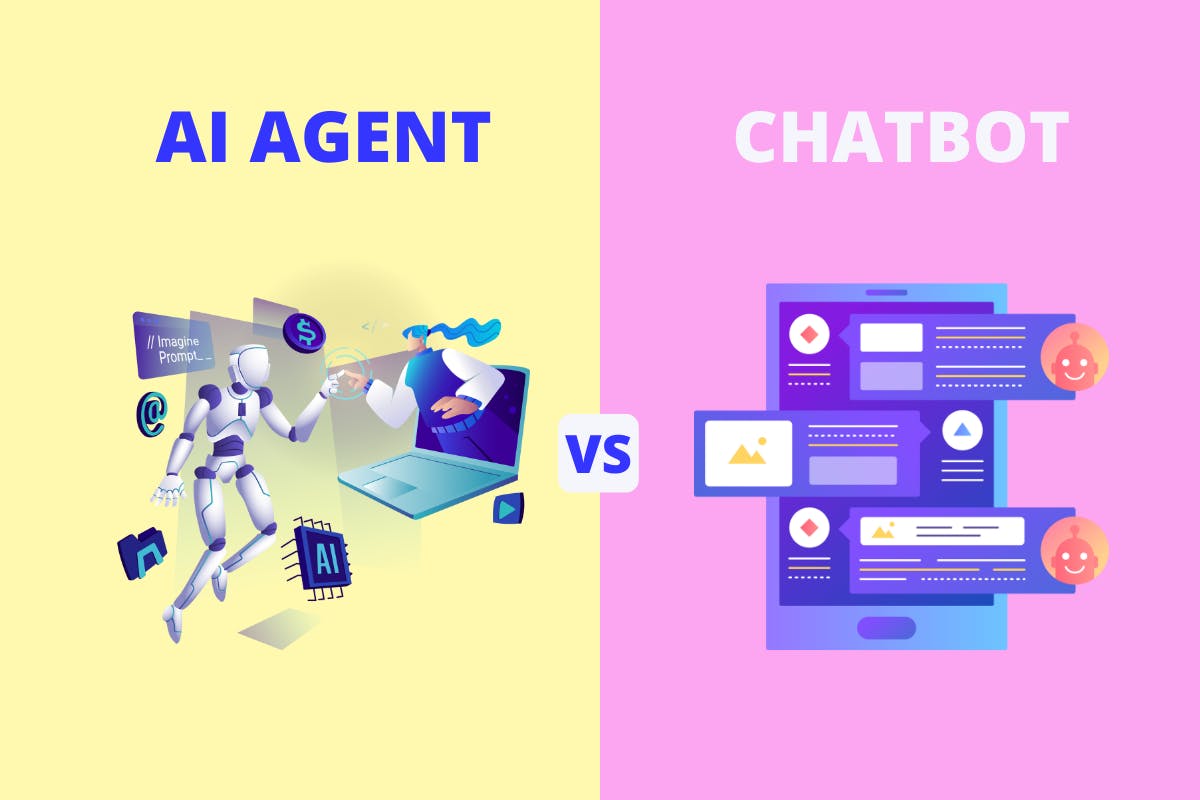
While the terms “AI chatbot” and “AI agent” are often used interchangeably, they represent two very different levels of intelligence and capability. A chatbot is primarily designed to converse, whereas an AI agent can reason, plan, make decisions, and perform tasks on behalf of a user.
As organizations increasingly adopt AI to improve productivity and customer experiences, understanding the distinction between chatbots and AI agents has become crucial. The difference is not merely technical—it shapes how businesses automate operations, interact with customers, and even build future digital workforces.
Credits: Make
The Rise of AI-Powered Automation
The journey began with basic rule-based chatbots that could only respond to predefined commands. These systems followed simple if-then rules and often struggled when conversations deviated from expected patterns.
The introduction of large language models (LLMs) transformed the chatbot landscape. Modern chatbots can understand natural language, generate human-like responses, and engage in complex conversations. Popular examples include customer support bots, virtual assistants, and conversational AI tools used by businesses worldwide.
However, organizations soon realized that answering questions was only one part of the equation. Users wanted AI systems that could not only provide information but also take action. This demand led to the emergence of AI agents.
What Is a Chatbot?
A chatbot is a software application designed to simulate human conversation. Its primary purpose is to interact with users through text or voice and provide responses based on user inputs.
Traditional chatbots rely on predefined scripts and decision trees. Modern AI chatbots leverage advanced language models to generate more flexible and natural responses.
Common chatbot functions include:
- Answering customer questions
- Providing product recommendations
- Handling basic support requests
- Booking appointments
- Assisting with FAQs
- Offering conversational assistance
For example, if a customer asks a chatbot, “What are your store hours?” the chatbot can quickly provide the information.
Similarly, a chatbot on an e-commerce website may help users locate products, check order status, or explain return policies.
The key characteristic of a chatbot is that it is generally reactive. It responds when prompted and performs limited actions within predefined boundaries.
What Is an AI Agent?
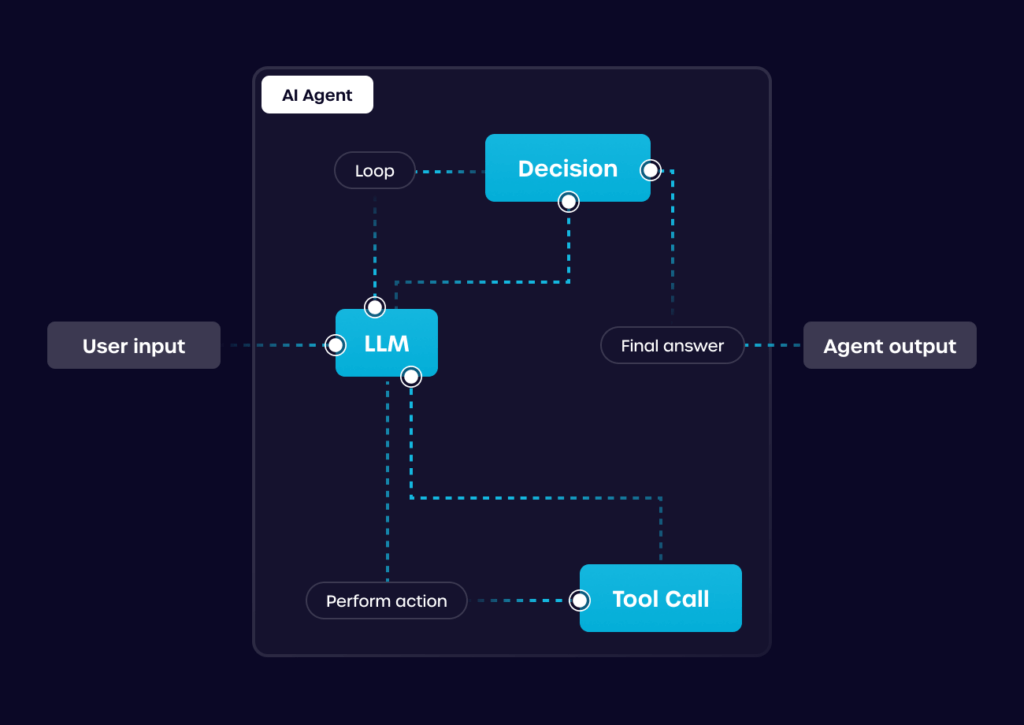
An AI agent is a more advanced system that can perceive information, make decisions, plan actions, and execute tasks to achieve a specific goal.
Unlike chatbots, AI agents are not limited to conversation. They can interact with multiple tools, software systems, databases, and digital environments to complete objectives autonomously.
An AI agent typically follows a cycle:
- Understand the goal
- Gather relevant information
- Create a plan
- Execute actions
- Evaluate results
- Adjust strategy if needed
For instance, imagine telling an AI agent:
“Find the cheapest flight to Singapore next month, compare hotel options, create an itinerary, and send me the best plan.”
Instead of merely explaining how to do these tasks, the agent can actively perform them by accessing travel platforms, analyzing prices, comparing options, and generating recommendations.
In essence, an AI agent behaves more like a digital employee than a digital assistant.
The Core Difference: Conversation vs Action
The simplest way to understand the distinction is this:
A chatbot talks.
An AI agent acts.
A chatbot focuses on communication, while an AI agent focuses on achieving goals.
For example:
When asked, “How do I renew my subscription?”
A chatbot might explain the renewal process.
An AI agent might log into the system, verify account details, renew the subscription, process payment, and confirm completion.
This ability to move beyond information delivery and into task execution is what makes AI agents significantly more powerful.
Credits: Thinkstack AI
How Chatbots Work
Modern chatbots are primarily powered by natural language processing (NLP) and large language models.
Their workflow typically includes:
Understanding User Input
The chatbot analyzes what the user is saying and identifies intent.
Generating a Response
Using either predefined rules or AI-generated text, the chatbot creates a relevant answer.
Maintaining Context
Advanced chatbots can remember parts of the conversation to provide more coherent responses.
Delivering Information
The chatbot presents answers, suggestions, or guidance.
While highly useful, chatbots usually operate within a confined scope and rarely make independent decisions.
How AI Agents Work
AI agents combine multiple technologies beyond language models.
Their architecture often includes:
Reasoning Engine
The reasoning system helps the agent determine what steps are needed to achieve a goal.
Memory System
Agents can maintain short-term and long-term memory, allowing them to learn from previous interactions and retain relevant information.
Tool Integration
AI agents can connect with external applications, APIs, databases, and software systems.
Planning Mechanism
Before taking action, agents can break large objectives into smaller tasks.
Feedback Loop
Agents continuously evaluate outcomes and adjust strategies when necessary.
This combination enables a level of autonomy that chatbots typically cannot achieve.
Real-World Examples of Chatbots
Chatbots are already deeply integrated into everyday digital experiences.
Customer Support Bots
Many companies use chatbots to answer common customer questions and reduce support workloads.
Banking Assistants
Banks deploy chatbots to help customers check balances, review transactions, and access account information.
E-Commerce Assistants
Online retailers use chatbots to guide shoppers through product discovery and purchasing decisions.
Healthcare Information Bots
Medical organizations employ chatbots to provide general health information and appointment scheduling assistance.
In these scenarios, the chatbot acts as an information provider rather than an autonomous decision-maker.
Credits: Sobot
Real-World Examples of AI Agents
AI agents are increasingly being deployed across industries.
Software Development Agents
Coding agents can write code, test applications, identify bugs, and suggest improvements.
Sales Agents
AI sales agents can qualify leads, schedule meetings, send follow-ups, and manage CRM systems.
Research Agents
These agents gather information from multiple sources, summarize findings, and create detailed reports.
Operations Agents
Businesses use operational agents to automate workflows, monitor systems, and optimize processes.
Personal Productivity Agents
Individuals can use AI agents to manage calendars, organize tasks, plan trips, and automate repetitive work.
These examples demonstrate how AI agents move beyond conversation and become active participants in workflows.
Why AI Agents Are Gaining Popularity
Several factors are driving the rapid adoption of AI agents.
Better Language Models
The capabilities of modern AI models have dramatically improved, making agents more reliable and capable.
Increased Automation Demand
Organizations are looking for ways to reduce manual work and improve efficiency.
Integration Ecosystems
Modern software platforms offer APIs that allow AI agents to interact with business systems seamlessly.
Labor Productivity
Companies see AI agents as a way to augment human workers and increase output without proportionally increasing costs.
As a result, many technology leaders view AI agents as the next major evolution of enterprise software.
Advantages of Chatbots
Cost Effective
One of the biggest advantages of chatbots is affordability. Businesses can deploy chatbots to handle thousands of customer inquiries without hiring additional support staff. This reduces operational costs while maintaining service availability. For startups and small businesses, chatbots often provide a practical way to offer round-the-clock support without the expense of a large customer service team.
Easy Implementation
Compared to AI agents, chatbots are significantly easier to implement. Many software providers offer plug-and-play chatbot solutions that can be integrated into websites, mobile apps, and messaging platforms within days. Organizations do not need extensive technical expertise or complex infrastructure to begin benefiting from chatbot technology.
Consistent Responses
Human customer support representatives can vary in knowledge, tone, and accuracy. Chatbots provide standardized responses, ensuring customers receive consistent information regardless of when or how they interact with the business. This consistency helps maintain brand quality and reduces the risk of misinformation.
Scalable Customer Service
A chatbot can engage with thousands of users simultaneously. During peak periods such as holiday sales, product launches, or promotional campaigns, chatbots can absorb large volumes of customer inquiries without affecting response times. This scalability is one of the primary reasons businesses continue investing in conversational AI.
Credits: Fingoweb
Advantages of AI Agents
End-to-End Task Execution
Unlike chatbots, which generally stop after providing information, AI agents can complete entire workflows. An employee might ask an AI agent to generate a report, gather supporting data, create a presentation, and schedule a meeting to discuss the findings. The agent can potentially handle every step of the process with minimal supervision.
Higher Productivity
By automating repetitive and time-consuming activities, AI agents allow employees to focus on creative, strategic, and relationship-driven work. Instead of spending hours collecting data or updating spreadsheets, workers can dedicate their time to decision-making and innovation.
Better Decision Support
AI agents can analyze large datasets, identify patterns, and generate recommendations. Because they can process information at a scale far beyond human capabilities, they often provide insights that might otherwise go unnoticed. This makes them valuable tools in fields such as finance, healthcare, logistics, and research.
Continuous Learning
Many AI agent systems are designed to improve over time. Through memory systems, feedback loops, and historical context, agents can refine their performance and become more effective at completing tasks. This creates a compounding effect where the value of the system grows with usage.
Cross-System Operations
One of the most powerful aspects of AI agents is their ability to operate across multiple platforms simultaneously. An agent may retrieve data from a CRM system, update a project management tool, send emails, and generate reports without requiring human intervention. This ability to connect workflows across systems dramatically expands the scope of automation.
Challenges Facing Chatbots
Limited Problem Solving
Although chatbots have become more sophisticated, they still struggle with tasks that require deep reasoning or multi-step planning. When conversations move beyond their intended scope, the quality of responses can decline rapidly.
Lack of Autonomy
Chatbots generally wait for user instructions before taking action. They rarely initiate tasks independently and often require constant guidance throughout an interaction. This limits their usefulness in situations where proactive problem-solving is needed.
Context Limitations
Even advanced conversational systems can sometimes lose track of long discussions. Users may need to repeat information or clarify earlier points, which can create frustration and reduce efficiency.
User Frustration
Almost everyone has experienced the frustration of interacting with a chatbot that fails to understand a request. Poorly designed chatbots can create negative customer experiences and, in some cases, drive customers away from a business altogether.
Credits: Sigmaschool
Challenges Facing AI Agents
Reliability Concerns
AI agents can perform complex tasks, but they are not infallible. Errors in reasoning, incorrect assumptions, or incomplete information can lead to undesirable outcomes. As agents become more autonomous, ensuring reliability becomes increasingly important.
Security Risks
Many AI agents require access to sensitive systems and data. If not properly secured, they could become targets for cyberattacks or misuse. Organizations must establish strict controls regarding permissions and access rights.
Governance Requirements
As AI agents gain more decision-making authority, businesses need clear governance frameworks. Questions such as who is responsible for an agent’s actions and what decisions it is allowed to make become critically important.
Higher Costs
Developing, deploying, and maintaining AI agents is often more expensive than implementing chatbots. The infrastructure, integrations, monitoring systems, and oversight mechanisms required for agentic AI can represent a significant investment.
Ethical Considerations
The rise of autonomous AI systems raises important ethical questions. How much decision-making power should organizations grant AI? What level of human oversight is necessary? How can transparency and accountability be maintained? These questions will likely become more important as AI agents become more capable.
Will AI Agents Replace Chatbots?
Not necessarily.
In many cases, chatbots and AI agents will coexist.
Chatbots excel at customer interactions, FAQs, and simple support tasks. They are efficient, affordable, and easy to deploy.
AI agents are better suited for workflows requiring reasoning, planning, and task execution.
A likely future scenario involves chatbots serving as the conversational front-end while AI agents operate behind the scenes.
For example, a customer may interact with a chatbot to explain a problem. The chatbot then delegates the request to an AI agent that completes the necessary actions.
This combination creates a seamless user experience while leveraging the strengths of both technologies.
The Future of AI Agents and Chatbots
The AI industry is moving toward increasingly autonomous systems. Major technology companies, startups, and enterprises are investing heavily in agentic AI, viewing it as the next phase of digital transformation.
Future AI agents may coordinate with one another, manage complex business processes, and function as virtual team members. Meanwhile, chatbots will continue evolving into more natural and capable conversational interfaces.
Rather than competing technologies, chatbots and AI agents represent different layers of the same AI ecosystem. One specializes in communication, while the other specializes in execution.

Credits: Salesforce
Conclusion
The difference between AI agents and chatbots comes down to one fundamental question: Does the system merely answer questions, or can it take meaningful action?
Chatbots are designed primarily for conversation. They provide information, answer queries, and assist users through natural language interactions. Their strength lies in communication.
AI agents, on the other hand, are designed to achieve goals. They can reason, plan, make decisions, and execute tasks across multiple systems. Their strength lies in action.
As artificial intelligence continues to advance, the world is likely to see a shift from AI that simply talks to AI that actively works. Businesses that understand this distinction will be better positioned to choose the right technology for their needs and unlock the full potential of intelligent automation.