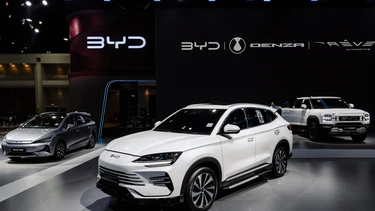
China’s largest automaker, BYD, has reportedly scaled back its ambitious 2025 sales target, signaling the sharpest slowdown in its growth trajectory in half a decade.
Target Trimmed by 16%
According to Reuters, citing people familiar with the matter, BYD has lowered its internal sales goal to around 4.6 million vehicles for 2025, a cut of nearly 16% from its initial projection of 5.5 million announced in March. The revised figure has been shared with select suppliers and insiders over the past month. While the target remains fluid depending on market conditions, the downgrade underscores growing headwinds for the world’s top electric vehicle (EV) manufacturer by volume.
Slower Growth After a Record Run
The latest target represents about 7% year-on-year growth from the 4.3 million vehicles BYD sold in 2024. That pace, however, would mark its weakest since 2020, when sales fell 7% during the pandemic. For context, BYD’s sales of EVs and plug-in hybrids skyrocketed tenfold between 2020 and 2024, cementing its place alongside global giants like General Motors and Ford.
The company’s blistering expansion appears to be losing steam, particularly in its core domestic market, which accounts for nearly 80% of sales. Deflationary pressures in China’s economy, exacerbated by a prolonged property slump, are weighing on consumer spending and auto demand.
Profit Takes a Hit
Signs of strain are already evident in BYD’s earnings. The automaker last week reported a 30% plunge in quarterly profit, its first decline in more than three years. Analysts have also tempered expectations: Deutsche Bank forecasts 2025 sales of 4.7 million vehicles, while Morningstar estimates 4.8 million—both in line with the company’s newly revised guidance.
BYD has slowed production, delayed factory expansions, and seen sales of economy cars under 150,000 yuan—its bread-and-butter segment—drop 9.6% year-on-year in July. Production also contracted for a second straight month in August, the first back-to-back decline since 2020.
Rivals on the Rise
Adding to the pressure is the intensifying competition from domestic peers. Geely Auto, for example, posted a 90% surge in sales in the sub-150,000 yuan category in July and has raised its 2025 target to 3 million vehicles from 2.71 million. Other rising challengers, such as Leapmotor, are also chipping away at BYD’s market share with aggressive pricing and new model rollouts.
The EV price war in China, sparked by Tesla’s cuts in 2023 and sustained by heavy discounting across the sector, continues to erode margins. While BYD has been better positioned than many to withstand the battle thanks to its vertical integration and cost advantages, even it is now feeling the squeeze.
Investor Sentiment Holds Steady
Despite the cloudy outlook, investor sentiment remains surprisingly upbeat. BYD’s U.S.-listed shares are up 23.8% so far in 2025. On Stocktwits, retail chatter around the company remains “bullish,” with message volume ranked as “high.”
Still, the reality is clear: BYD’s era of breakneck growth is giving way to a more competitive, slower-burning phase. Whether it can defend its leadership in China’s EV market, or expand faster overseas to compensate will define its next chapter.