In a digital age where social media footprints are closely monitored, a recent case has stirred debate about the fairness and technicalities behind U.S. visa procedures. A visa applicant has claimed their student visa was delayed — and possibly denied — over an already-public Reddit account that was allegedly not visible to the officer reviewing the application.
Here’s a closer look at what happened, what it means for future applicants, and why the U.S. is tightening its grip on online activity.
The Reddit Revelation: A Shocking Visa Interview Experience
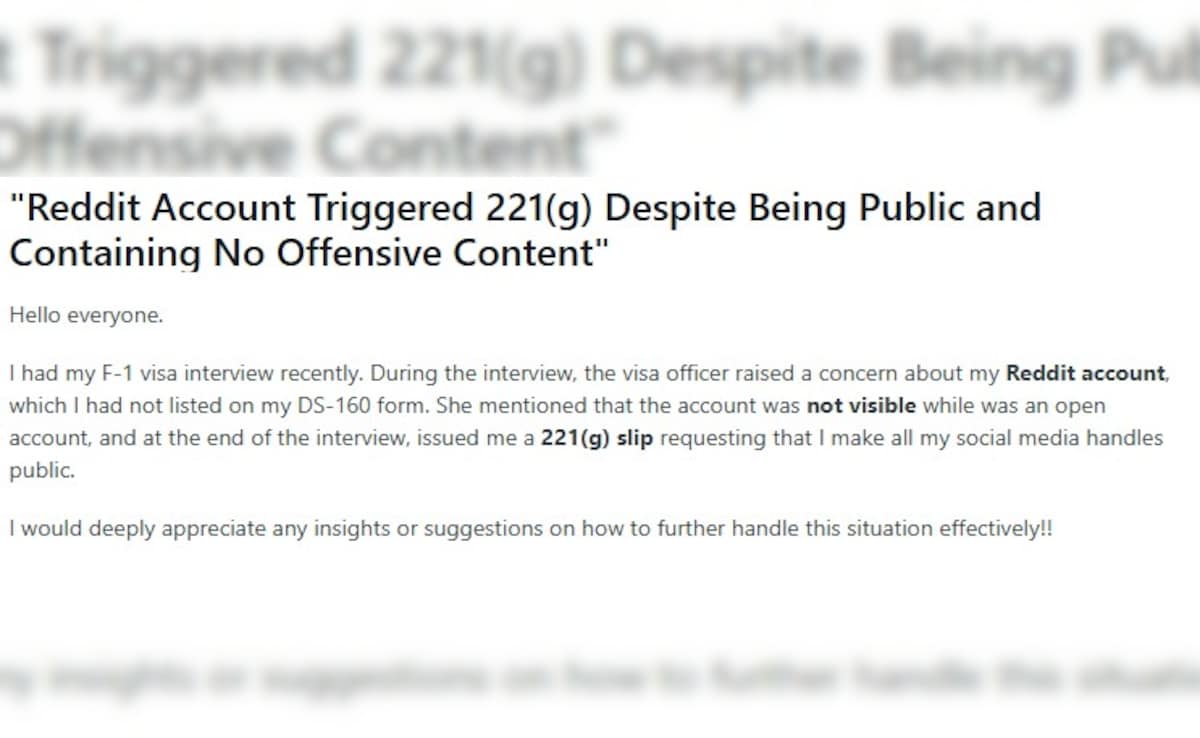
In a post shared on a visa-related subreddit, an international student described their recent F-1 visa interview experience at a U.S. consulate. During the interaction, the visa officer reportedly raised a concern over the applicant’s Reddit account — a detail the applicant had not included in their DS-160 visa form.
While platforms like Instagram, Facebook, and Twitter are commonly listed in the social media section of the DS-160, Reddit often slips under the radar. However, the U.S. State Department requires disclosure of all platforms listed in the dropdown menu, which includes Reddit.
Despite the applicant claiming the Reddit account was already public and contained no offensive material, the visa officer told them the account was not visible and subsequently handed them a 221(g) slip — a temporary refusal that requires further processing.
Credits: NDTV
What Is a 221(g) Slip? And Why Does It Matter?
Form 221(g) is issued when a consular officer determines that additional information or processing is required before a final decision can be made on a visa application. In this case, the applicant was instructed to make all their social media handles public — a step they had already believed they had taken.
The applicant’s major concern now is technical: What if the system continues to misread their account as private? Will that lead to a permanent denial? With no clarity on how the State Department checks privacy settings on Reddit or other platforms, the fear is understandable.
Why Is the U.S. Monitoring Social Media?
The policy of social media vetting was formally introduced in 2019 under the Trump administration. It mandated that nearly all U.S. visa applicants provide details of their social media accounts used in the past five years. The intent: to thoroughly vet applicants and detect any potential threats before they enter the U.S.
In June 2025, the U.S. Embassy issued a notification reaffirming this stance. It directed all F (academic students), M (vocational students), and J (exchange visitors) visa applicants to set their social media profiles to public as a mandatory requirement for visa processing.
“Effective immediately, all individuals applying for an F, M, or J nonimmigrant visa are requested to adjust the privacy settings on all of their social media accounts to public to facilitate vetting,” the notification stated.
Officials argue that this level of access helps them verify the identity, intent, and admissibility of applicants under U.S. law.
From Vetting to Surveillance: A Fine Line?
While the U.S. maintains that a visa is a privilege, not a right, critics argue that this form of surveillance could potentially cross ethical lines. What if a visa is denied not based on actual wrongdoing, but because of a technical glitch, subjective interpretation, or algorithmic error?
In this case, the Reddit user’s account was public. Yet, due to a potential visibility error or backend screening limitations, it was flagged as non-compliant — leading to a painful and uncertain visa delay.
What This Means for Future Applicants
This incident serves as a stark reminder for all international visa applicants:
-
List all platforms honestly on your DS-160 — including Reddit.
-
Double-check your privacy settings on each platform from multiple devices or accounts to ensure they’re truly visible to the public.
-
Keep documentation or screenshots of your public profiles as evidence in case you are asked for clarification.
Most importantly, be proactive. The digital realm is no longer private when it comes to U.S. immigration — and even the smallest oversight could cost you the opportunity of a lifetime.

Credits: Mint
Conclusion
As the U.S. sharpens its immigration scrutiny, social media vetting is becoming more than a formality — it’s a frontline filter. This Reddit case might just be the tip of the iceberg for a generation of digital-native applicants navigating an increasingly monitored visa landscape.