The technological landscape has changed more quickly than nearly anyone anticipated thanks to the generative AI revolution. OpenAI and Anthropic, two businesses engaged in a fierce struggle for supremacy, are at the heart of this change. One of the biggest corporate rivalries in contemporary tech history started out as a disagreement over the future of artificial intelligence.
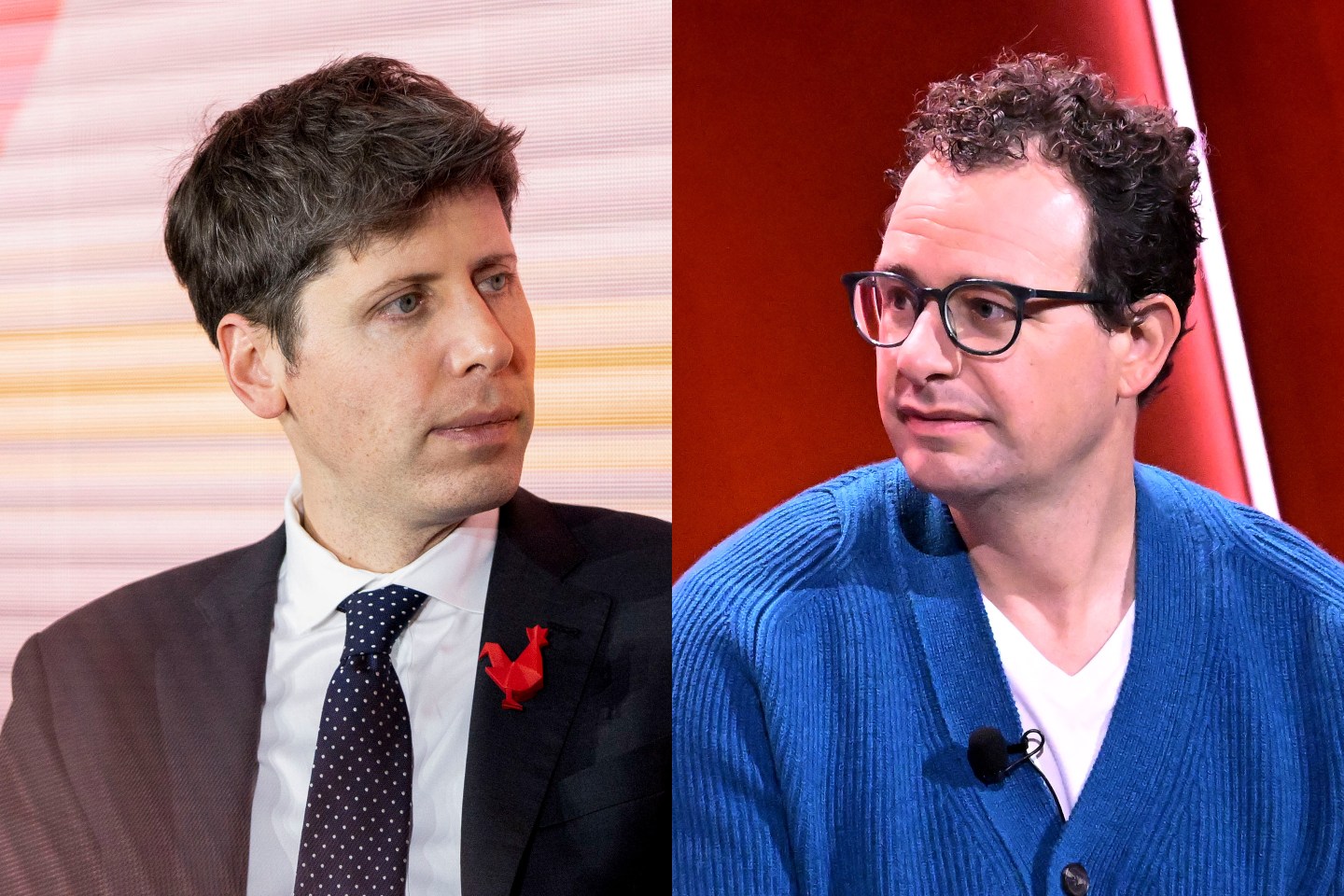
Credits: Fortune
From Colleagues to Competitors
The roots of the rivalry can be traced back to 2020 when Anthropic CEO Dario Amodei left OpenAI along with several researchers to establish Anthropic. The new company positioned itself as an AI lab focused heavily on safety, transparency, and responsible development.
Meanwhile, under the leadership of Sam Altman, OpenAI continued pursuing increasingly powerful AI systems with the ambition of bringing artificial general intelligence (AGI) to the world.
The split was more than a business decision—it represented two different philosophies about how advanced AI should be built and deployed.
The ChatGPT Moment That Changed Everything
The rivalry accelerated dramatically in late 2022. Reports suggest that OpenAI learned Anthropic was developing a chatbot product, prompting a rapid internal push to release ChatGPT. The result was one of the most successful product launches in technology history.
ChatGPT became the fastest-growing consumer application ever, attracting millions of users within weeks and introducing generative AI to the mainstream.
Anthropic launched Claude shortly afterward. While Claude initially trailed ChatGPT in public awareness, it steadily gained recognition among developers and enterprise customers for its reliability, longer context windows, and emphasis on safety.
Today, Claude and ChatGPT are widely viewed as the two leading AI assistants in the world.
A Battle of Different Business Strategies
Although both companies build advanced AI models, their business approaches differ significantly.
OpenAI has built a massive consumer ecosystem around ChatGPT, attracting hundreds of millions of users. The company has expanded into search, coding, productivity, voice assistants, and enterprise software.
Anthropic, by contrast, has focused more aggressively on enterprise customers and developers. Its Claude models are heavily used by businesses seeking AI tools for coding, research, customer support, and workflow automation.
This divergence has created an interesting dynamic: OpenAI dominates consumer mindshare, while Anthropic has become a favorite among many enterprises and software developers.
The Race for AI Supremacy
The competition extends far beyond chatbots.
Both companies are racing to develop reasoning models capable of solving complex problems, writing software, conducting research, and performing tasks that previously required human expertise.
OpenAI’s GPT models and Anthropic’s Claude family now compete feature-for-feature across coding, reasoning, multimodal capabilities, and agentic workflows.
Whenever one company launches a major upgrade, the other often responds within weeks or months. This cycle of competition has accelerated innovation across the entire AI industry.
For users, the rivalry has been beneficial. Faster releases, lower costs, and increasingly capable AI systems are direct outcomes of this competitive pressure.
Wall Street’s Next Big Showdown
The rivalry is now moving into a new arena: public markets.
Both companies have reportedly begun taking steps toward blockbuster IPOs. Investors view the listings as potentially historic events that could rival some of the largest technology offerings ever seen.
Being first matters. The company that reaches public markets first could influence how investors value AI businesses, establish key financial benchmarks, and strengthen its position as the industry’s leader.
Beyond technology, the battle now involves investment banks, institutional investors, regulators, and global markets.
More Than a Corporate Competition
The OpenAI-Anthropic rivalry is about more than revenue, market share, or valuations. It represents competing visions for the future of artificial intelligence.
OpenAI emphasizes rapid deployment and broad adoption, while Anthropic places greater emphasis on alignment, safety, and controlled development. Yet both share the goal of building increasingly capable AI systems that could redefine how humans work, learn, and create.
Credits: Business Insider
Conclusion
OpenAI against Anthropic is one of the few rivalries that has had such a significant impact on a nascent sector. What began as a disagreement between former coworkers has developed into a competition impacting future stock markets, enterprise adoption, AI safety regulations, and product innovation. Their rivalry will probably decide not only who leads the AI sector but also how everyone’s experience with AI develops in the future as both businesses strive for more potent AI systems and possibly record-breaking initial public offerings.