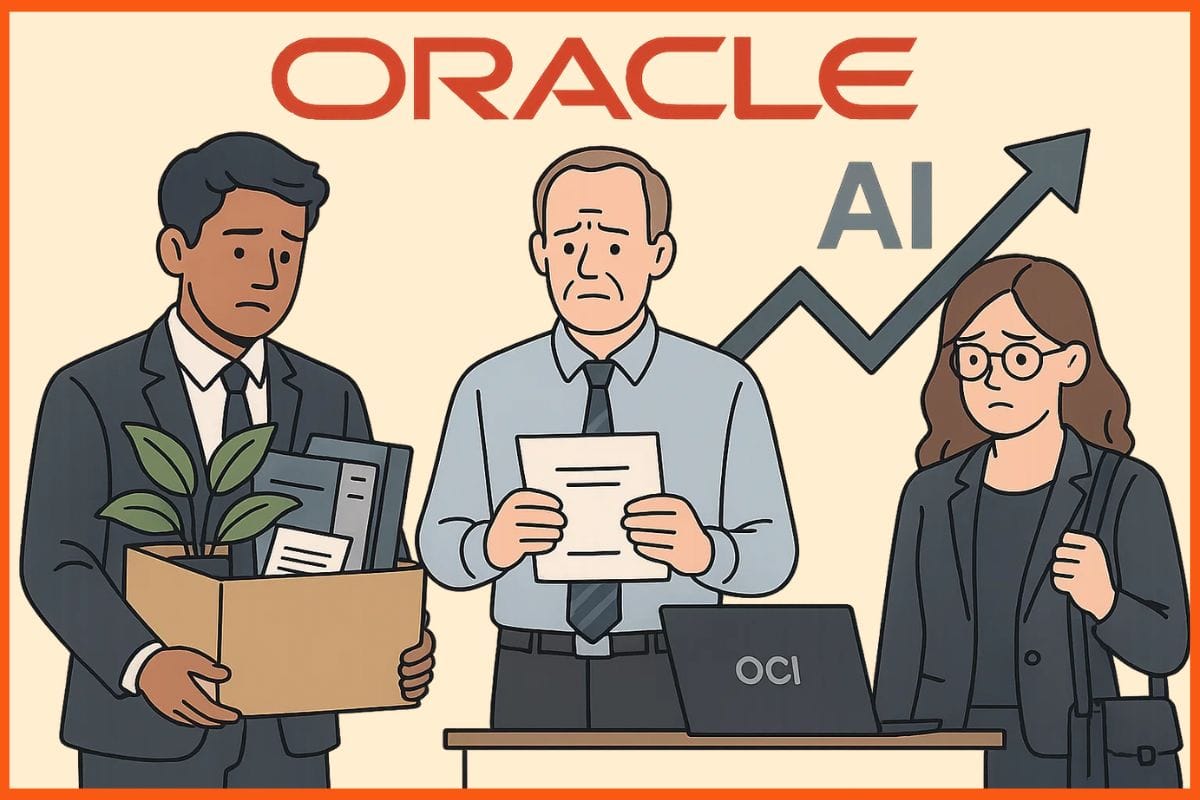
The storm of tech layoffs refuses to calm down. After Intel, Google, and TCS trimmed their teams, Oracle has now axed nearly 10% of its Indian workforce—and the timing couldn’t be more controversial. With almost 3,000 jobs on the line, this isn’t just about restructuring. It’s about geopolitics, AI, and the future of India’s IT talent.
Credits: StartupTalky
The Scale of the Shock
India has always been a jewel in Oracle’s global operations. With 28,800 employees spread across Bengaluru, Hyderabad, Chennai, Pune, Noida, and Mumbai, the company has deep roots in the country’s IT ecosystem.
But the axe has fallen hardest on teams in software development, cloud services, and customer support—roles that many assumed were safe. For thousands of workers, the sudden layoffs have left careers in limbo, fueling frustration and uncertainty across the sector.
The Curious Timing
Oracle insists this is just part of a global restructuring exercise, but the timeline raises eyebrows. Days before the announcement, Oracle CEO Larry Wilson was photographed at the White House with US President Donald Trump. On the table? Talks about hiring more in the US, strengthening data security, and forging tech partnerships.
Almost immediately after that meeting, Oracle proudly unveiled a mega-deal: OpenAI will now rely on Oracle’s infrastructure to power large-scale AI workloads.
Coincidence? Many in the industry aren’t so sure. The layoffs in India, coupled with promises of new US jobs, have triggered whispers that Oracle is shifting its bets westward.
Reactions Across India
The news has struck a nerve. Social media is buzzing with outrage. Words like “barbaric” and “heartless” are being thrown at the company for leaving thousands of IT workers stranded.
But there’s also a sense of nervous acceptance. Industry veterans warn this may be just the tip of the iceberg, as more global giants could follow Oracle’s lead. With AI, automation, and politics dictating corporate strategies, Indian tech workers may find themselves in an increasingly vulnerable spot.
AI at the Center of It All
Look closer, and a pattern emerges. Oracle’s pivot towards OpenAI isn’t just a business deal—it’s a signal of where the industry is heading. Artificial intelligence is rewriting the playbook.
Traditional roles in software development and customer support are increasingly being automated or restructured, while demand is exploding for AI engineers, data scientists, and cloud infrastructure experts.
For Oracle, cutting legacy roles may simply be the price of staying competitive in a race dominated by AWS, Microsoft Azure, and Google Cloud. For employees, however, it feels like the rug has been pulled out from under them.
What It Means for India
The big question now: where does this leave India’s IT workforce?
For employees, the message is loud and clear—upskill or be left behind. Those who can pivot to AI, cloud architecture, and advanced data engineering will likely thrive. For everyone else, the path looks uncertain.
For policymakers, Oracle’s move is a wake-up call. India has pitched itself as a global tech hub for decades, but if US and European politics push companies to “hire local” abroad, India may have to reinvent its strategy to keep jobs flowing.

Credits: Deccan Founders
Conclusion: A Turning Point
Oracle’s decision to slash nearly 10% of its Indian workforce is not just another layoff story—it’s a turning point. It reflects how geopolitics, AI disruption, and corporate priorities are colliding to reshape the future of work.
For India’s IT sector, this is both a shock and an opportunity. The shock lies in the scale of the cuts. The opportunity lies in recognizing that the future belongs to those who adapt fastest.
In other words: the AI era has arrived, and the clock is ticking.