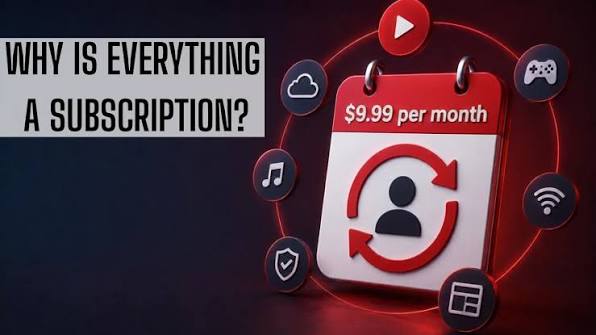
Subscription-based services have become widespread, and today customers regularly pay money for movies, music, cloud storage space, software, fitness apps, and even car components that used to be purchased in one piece. Instead of one-time purchasing, consumers are expected to pay on a regular basis. It is no wonder why many people started to ask themselves, “Why everything is becoming a subscription?”
There are multiple reasons behind this tendency, and it includes aspects of business strategy, technology, customer preferences, and modern economic situation. While businesses seek stability, many customers prefer low initial prices and periodic upgrades, but at the same time, it leads to certain problems, including increasing prices and losing ownership of the product.
This article will explain why everything is becoming a subscription, why businesses use it, its pros and cons, and how to choose a good subscription.
What Does the Subscription Economy Mean?
To comprehend why everything is a subscription, you first have to comprehend the subscription economy.
Rather than making a sale once, firms are offering continual access through monthly/yearly payment structures, which you will keep on paying for as long as you would like to use it.
The concept began with magazines/newspapers but today is applicable to every other sector, such as:
- Streaming services for video
- Streaming services for music
- Software
- Cloud Storage
- Video games
- Online education
- Fitness applications
- Home automation services
- Car services
Why Everything Is Becoming a Subscription: Predictable Revenue
The most important reason for the fact that everything is turning into a subscription is the predictability of income.
Sales generate income based on the purchases that customers make. This income fluctuates from month to month.
Subscription solves this problem by providing companies with knowledge about their income from current customers even before the month starts.
It becomes easier for a company to:
- Make future investments
- Recruit staff
- Develop new products
- Calculate future profit
It is more attractive to investors to invest in companies that generate recurrent income.
Customers Spend More Over Time
Customer lifetime value is another key factor that is contributing to making everything a subscription.
Take, for example, the following two customers:
- Customer A purchases a piece of software for $150.
- Customer B pays $15 per month.
After one year, Customer B would have paid $180, while in three years they would have paid $540.
Although the monthly payment seems small, in many cases it actually yields far greater profits.
Technology Makes Subscriptions Easy
Cloud computing has revolutionised product delivery.
A number of services can be accessed via the internet rather than installing the product on your PC.
It is yet another factor making everything subscription-based.
The cloud technology requires businesses to keep paying for:
- Servers
- Storage space
- Security
- Updates
- Tech support
Such costs go on; hence, businesses need to make recurring payments which correlate with their costs.
Software-as-a-Service (SaaS) is one of the most successful applications of this concept.
Small Monthly Payments Feel Affordable
It is also consumer psychology that leads to everything being a subscription.
Consumers will find it easy to make a payment of $10 every month compared to having to pay $200 up front even if the cost is significantly higher after several years.
Users will not be conscious of the payment since it is automatic, thus reducing resistance.
Companies Can Keep Improving Products
Every subscription service is not created for merely making money alone. There are some subscription services that need continuous development. Streaming websites update their content. Cloud hosting services increase their security. Software firms provide updates and new additions to software. Consistent income enables firms to keep developing the product without having to wait for years to sell a new version.
It makes perfect sense for many digital products.
Ownership Is Slowly Disappearing
One of the most significant transformations that have led to everything becoming a subscription is the change from owning to renting.
A while back, when one bought a DVD, music CD, or any other software on a disc, he/she owned it for life.
Nowadays, however, a lot of what one pays for offers temporary access only.
Once the payments cease, then:
- Software stops functioning.
- Cloud storage is restricted.
- Access to streaming libraries ceases.
Consumers no longer own many digital products. Instead, they rent access for as long as they continue paying.
Subscription Fatigue Is Growing
With the adoption of subscriptions increasing across different sectors, there is a growing feeling among many consumers of subscription fatigue.
Just a few dollars a month might not be too costly.
However, when you consider:
- Streaming subscriptions
- Music subscriptions
- Productivity applications
- Cloud storage subscriptions
- Gaming subscriptions
- Fitness applications
- AI-based software
Your total monthly cost will be higher than what you would expect.
Why Everything Is Becoming a Subscription Beyond Software?
No more do subscriptions apply only to digital goods. Automobile makers are charging monthly amounts for high-end functionalities.
Coffee companies are providing their products through subscription models.
Ink subscriptions are being provided by printer companies.
Smart devices need subscriptions for cloud services.
Even home security systems need monthly subscriptions to work.
The idea here is that once a product is capable of going online, then a recurring payment model is possible.
The Downsides of Subscription Services
Although subscriptions offer convenience, they also create several challenges.
Higher Long-Term Costs
A product that costs $15 every month can easily become more expensive than buying it outright.
Over several years, recurring payments often exceed the price of a traditional purchase.
Less Control
Companies can:
- Raise prices
- Remove features
- Change terms
- Limit access
Customers have little control over these decisions.
Harder Cancellation
Some businesses make canceling more difficult than signing up.
Long cancellation processes can lead customers to continue paying even when they no longer use the service.
Regulators around the world have started paying closer attention to these practices.
When Subscriptions Actually Make Sense?
Subscriptions, however, are not necessarily a bad deal even amid such criticism. It makes sense when:
- The products are frequently updated.
- Cloud infrastructure is required for the service.
- There is no need for the product in the long run.
- It would cost more to purchase the product outright.
It also allows businesses to scale easily depending on their changing needs.
The worth lies in the frequency of utilization of the services.
How to Decide Whether a Subscription Is Worth It?
Here are a few easy questions to consider before subscribing to anything.
- Will I use this every month?
- How much does it cost me in three years?
- Is there any one-time payment option available?
- Can I unsubscribe easily?
- What happens if prices go up?
Asking these questions helps us avoid wasting money on unnecessary services.
The Future of the Subscription Economy
The subscription economy will likely continue growing.
Artificial intelligence, connected devices, electric vehicles, and cloud computing all support recurring business models.
At the same time, consumers are becoming more selective.
Many people now review their subscriptions regularly and cancel services they no longer use.
This trend may encourage companies to offer more flexible pricing, better value, and easier cancellation processes.
Final Thoughts
“Why Everything is Becoming a Subscription” can be answered by multiple reasons. First of all, companies have several advantages, including stable revenues, higher value of customer lifetime and closer relationships with customers. The modern technology made subscription services more convenient than ever.
For customers, subscriptions give convenience, constant updates and lower initial payment, but in general, subscriptions cost much more, and people get no ownership over their digital products.
Knowing why everything is becoming a subscription will help you to make more sensible purchase decisions. Instead of signing up for each service that appears every month, compare the price in the long term and usage frequency.