Chinese Premier Li Qiang made a sweeping appeal for international collaboration on artificial intelligence at the weekend, calling for the creation of a new global body to regulate the development and security of AI just days after President Trump launched America’s aggressive deregulation crusade for the tech sector.
In Shanghai on Saturday at the World Artificial Intelligence Conference, Li referred to AI as a “new engine for growth” but warned that current methods of governance are still piecemeal across the world. His counsel is well-timed when the world’s two biggest economies are in a heightened technological rivalry, AI quite possibly the most critical front.
The Quest for International Standards
Li emphasized the urgent need for world consensus on AI management, particularly on finding a balance between development and security. “The threats and dangers brought forth by artificial intelligence have attracted the common attention of the whole world,” the prime minister stated.
“How to balance development and security is something that needs to be decided urgently by the whole society.”
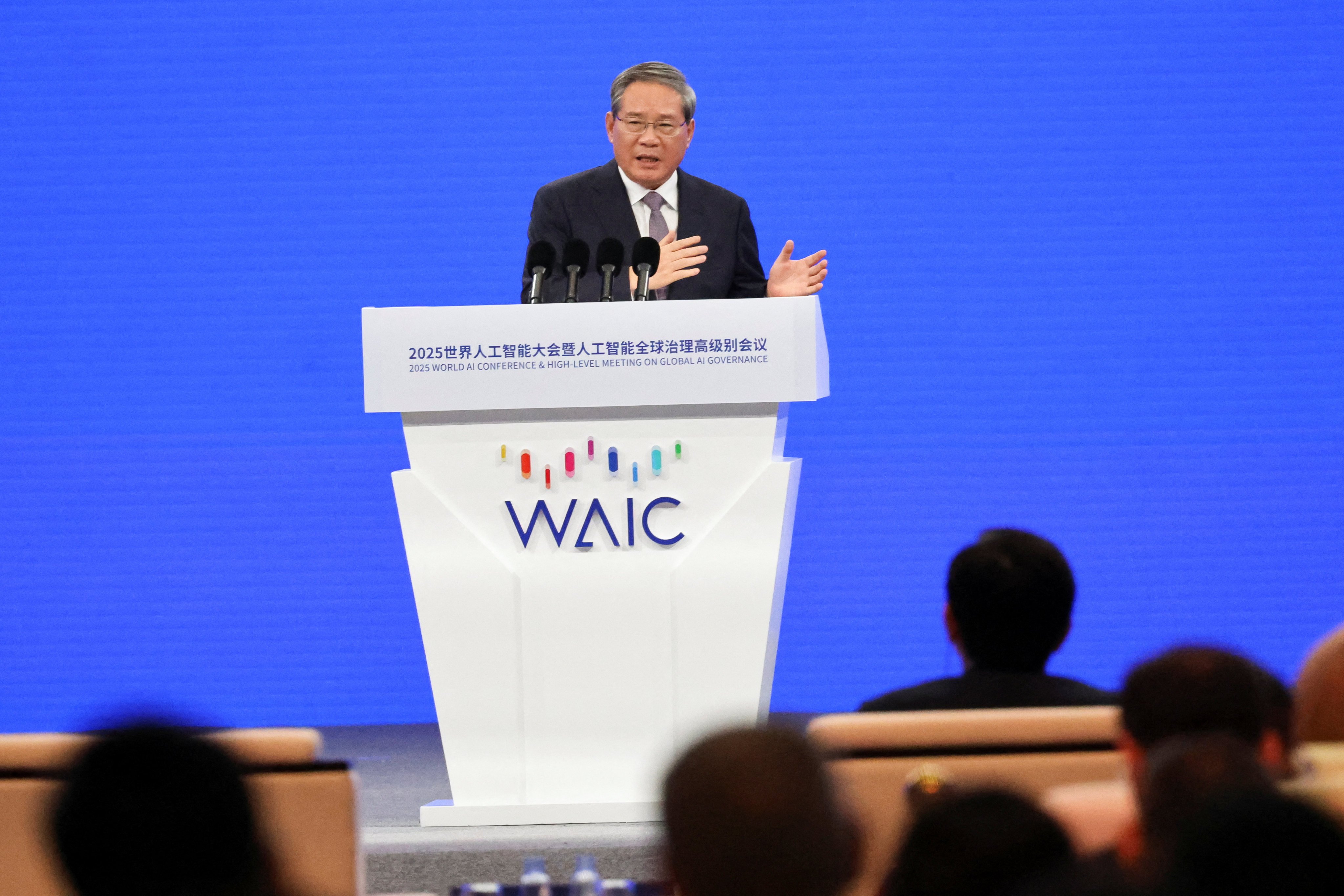
The timing of Li’s remarks is telling. Just days earlier, Trump had posted a statement on his administration’s low-regulation approach to cementing America’s position at the leading edge of AI. One of Trump’s executive orders was directed specifically against what the White House had labeled as “woke” artificial intelligence systems, an entirely different philosophy than that which it appears China is promoting.
Open-Source Promise of China
Li made several commitments in his speech that can change the direction of world AI development. Most noticeably, he promised that China would “actively promote” open-source AI research and transfer technology gains to other countries, particularly developing countries.
That is far from the recent trend of technology giants to zealously guard their AI breakthroughs.
The Prime Minister himself did not name the United States in his speech, but his unease was palpable. He warned that AI could become an “exclusive game” for certain countries and companies, citing concerns about a lack of availability of AI chips and talent mobility between countries.
Li’s remarks on chip shortages are directed at one of the most controversial elements of the US-China technology competition. Washington has imposed extreme restrictions on the export of advanced AI chips, such as those produced by firms like Nvidia, and the specialized equipment required to produce them. US officials have defended the restrictions on the grounds that the technology might make China’s military more powerful.
These trade restrictions have made it unnecessarily difficult for Chinese AI companies, and they have had to turn to workarounds or devise their own alternatives to US-manufactured chips. Li’s call for greater global cooperation can be understood as a response, at least in part, to these trade restrictions.
Global Issues and Challenges
The AI revolution is stirring existential concerns that extend well beyond US-China competition. Recent studies have shown AI’s potentially ruinous impact on media companies, some of which estimated AI-created search abstracts would reduce website traffic by as much as 80%. Media companies are particularly worried about being left behind online as search engines increasingly serve up AI-created results instead of directing readers to original content.
Apart from media, AI integration into almost all industries has fueled controversy relating to employment impacts, disinformation, and the possibility of losing control over pivotal technologies.
This year’s World AI Conference included a star-studded lineup. Geoffrey Hinton, commonly known as “the godfather of AI,” former Google CEO Eric Schmidt, and Anne Bouverot, French president special envoy for AI, were among the speakers. Missing from the lineup was Tesla CEO Elon Musk, who has been a regular in previous years.
The exhibition floor had mostly Chinese companies, including tech giants Alibaba and Huawei, and upstarts like Unitree, which makes humanoid robots. Western players that turned up were Tesla, Alphabet, and Amazon, indicating that business relations in AI are robust even during times of political tensions.
As AI technology forges ahead at breakneck speed, Li’s call for global cooperation poses the ultimate question of our time: whether the world’s great powers can come together to harness this revolutionary technology or whether it will be utilized as yet another arena of great power competition. The answer will likely determine the course of AI itself and who benefits from its enormous potential.