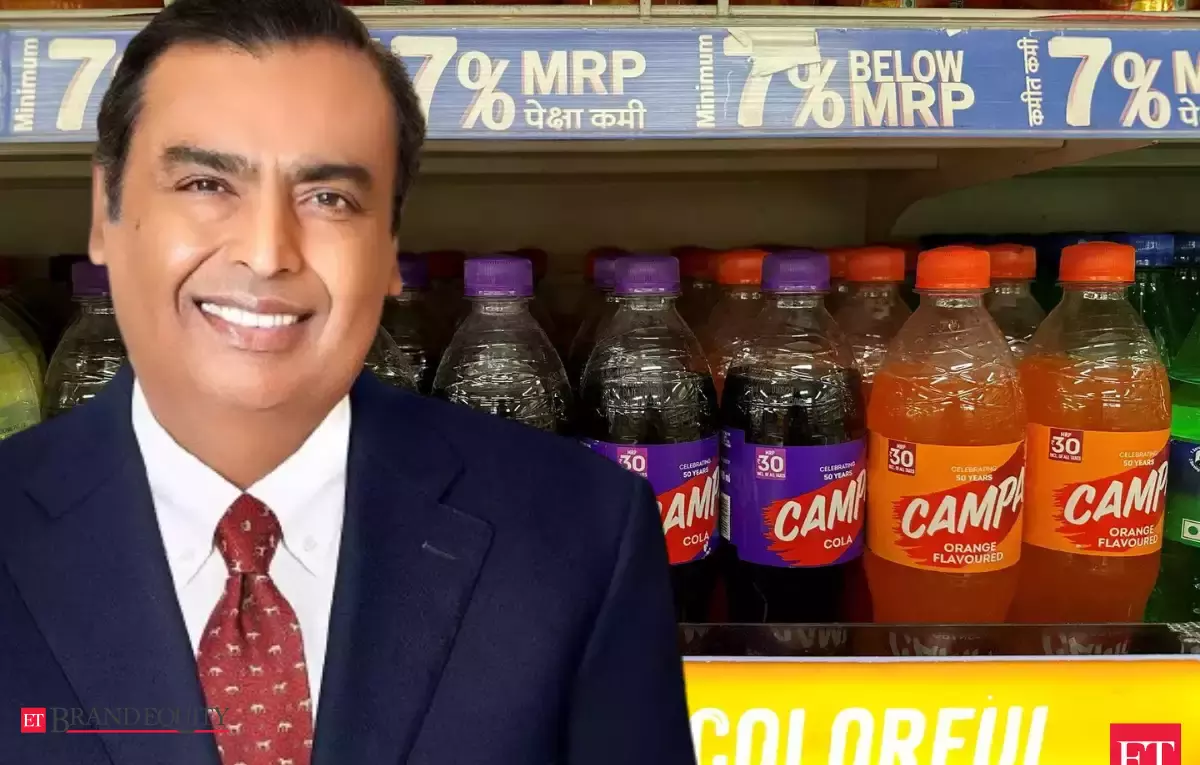
India’s soft drink market is undergoing a major shift, and at the center of this change is a name that had all but disappeared from supermarket shelves for decades: Campa Cola. Once a household favourite during the pre-liberalisation era, Campa Cola was pushed aside by the arrival of global brands like Coca-Cola and Pepsi. Now, Reliance Industries, through its consumer arm Reliance Consumer Products Ltd (RCPL), has brought Campa Cola back.
Backed by one of the country’s most influential business groups, Campa Cola is attempting to reclaim its space in a market that has long been controlled by foreign players. The move is not just about bringing back an old name. It is a calculated business decision with clear intent—offering a nostalgic Indian alternative while aiming for large-scale disruption through pricing, marketing, and distribution.
Campa Cola was once a symbol of local success, built during a time when India had limited access to foreign goods. During the 1970s and 1980s, with Coca-Cola exiting the Indian market in 1977 due to regulatory pressures, local brands like Campa Cola had their moment. The drink became popular across Indian cities and towns, sold in glass bottles with advertisements that carried a proud, distinctly Indian tone. Its slogan “The Great Indian Taste” carried both emotional and cultural weight.
Campa Cola stood for self-reliance, an Indian product competing against the absence of multinational giants. But by the mid-1990s, with economic liberalisation opening the doors to foreign investment, the re-entry of Coca-Cola and PepsiCo changed the game completely. Campa Cola lost its market share, infrastructure, and consumer mindshare, slowly disappearing from major cities and eventually becoming a forgotten brand.
The revival of Campa Cola is not a random nostalgic project. It is part of Reliance’s broader strategy to build a wide-ranging consumer products portfolio. The acquisition of the Campa brand by RCPL for around ₹22 crore was a calculated move. Reliance recognised the emotional pull that Campa Cola still held, especially among older consumers who remembered it from their childhood.
This emotional connection offers a kind of brand equity that cannot be manufactured easily. But Reliance has made it clear that it does not plan to depend on nostalgia alone. The intention is to use Campa Cola as a platform for creating a competitive cola product that can reach both urban and rural consumers.
A major part of this strategy lies in Reliance’s unmatched distribution network. With JioMart, Reliance Retail stores, and a vast network of local kirana partners under its belt, the company has the ability to push Campa Cola into corners of the country that many brands struggle to access. This gives it an immediate edge, especially in semi-urban and rural areas where affordability and availability often shape consumer choices.
Campa Cola’s pricing strategy — offering a 200ml bottle for just ₹10 — also signals Reliance’s approach. It is an aggressive, volume-based play, echoing the tactics that made Jio successful in the telecom space.
The comparison with Jio is not far-fetched. When Jio was launched, it disrupted the telecom industry with ultra-cheap data and free voice calls. This pricing forced other telecom players to lower their rates, leading to a complete change in the market structure. A similar method is being applied to the soft drink market now.
While Coca-Cola and PepsiCo have relied on their strong marketing budgets and well-established distribution channels, they have also kept their price points above what many consumers in smaller towns can afford regularly. Campa Cola, priced lower and marketed as a local product, has the potential to disrupt that pattern, especially during peak demand periods like summer.
In 2025, RCPL made its most aggressive move by securing IPL 2025 sponsorship rights for ₹200 crore. This is not a small investment. It shows Reliance’s clear focus on visibility and mass recall. The Indian Premier League is one of the most watched events in the country, and associating Campa Cola with the IPL puts it directly in front of millions of viewers across every age group. This kind of national platform allows the brand to not only gain quick attention but also reset its image among younger consumers who may not even have heard of Campa Cola before. By using the IPL as a launchpad, Reliance is making a clear statement: Campa Cola is not just back, it wants to be seen and remembered.
But Reliance is not stopping at cola. Alongside Campa, RCPL has launched other beverages including Spinner, a sports drink developed in partnership with former Sri Lankan cricketer Muttiah Muralitharan, and RasKik Gluco Energy. Spinner has also been signed on as a sponsor with five IPL teams: Mumbai Indians, Lucknow Super Giants, Gujarat Titans, Punjab Kings, and SunRisers Hyderabad. This multi-brand visibility approach shows Reliance’s intention to make a serious dent in India’s beverage segment, which is still largely led by a handful of players.
Of course, this attempt comes with challenges. Coca-Cola and PepsiCo are not passive competitors. Coca-Cola has reinforced its partnerships with IPL teams like Chennai Super Kings and Kolkata Knight Riders, and is also strengthening its retail presence through its connection with Jubilant Foodworks, the company behind Domino’s Pizza in India. With over 1,000 Domino’s stores and the sale of Pepsi products through this network, the international brands continue to hold a solid advantage in urban markets and quick-service restaurants. Coca-Cola’s partnership with Hindustan Coca-Cola Beverages, partly owned by the Bhartia group, strengthens its backend supply and retail chain further.
Still, there is a shift in consumer preference. Many younger consumers are looking for brands that feel more connected to Indian roots. Reliance is banking on this sentiment. By promoting Campa Cola as “Naye India Ka Apna Thanda,” the brand is being pitched not just as a drink, but as something familiar, rooted in the country’s past, and proudly Indian. It is an emotional appeal, but paired with serious business strategy. The goal is not just to create a soft drink, but to build a consumer brand that can compete in both value and volume.
The market conditions are also changing in ways that favour new players. According to the Indian Council for Research on International Economic Relations (ICRIER), the beverage market in India—including soft drinks, bottled water, juices, and energy drinks—was valued at ₹67,100 crore in 2019. This figure is expected to touch ₹1.47 trillion by 2030. This growth offers room for new brands like Campa to find their share. While the top brands may continue to dominate urban centres and premium retail chains, the opportunity in Tier 2 and Tier 3 cities, and rural areas, is wide open. If Campa Cola can establish a strong presence in these regions with its affordable pricing and strong distribution, it stands a real chance of building sustainable volume.
Product innovation is also likely to play a key role. Coca-Cola and PepsiCo offer a variety of flavours, package sizes, and seasonal campaigns. Campa Cola will need to respond with product extensions—perhaps fruit-based versions, zero sugar variants, or chilled packs for outdoor retail. It will need packaging that appeals to both budget-conscious buyers and premium consumers. The story of Campa Cola’s comeback is only just beginning, and product development will determine whether it becomes a lasting name again or fades into nostalgia a second time.
Reliance’s move with Campa Cola is also being closely watched by the broader consumer goods market. If this approach works, it may serve as a blueprint for reviving other Indian brands that lost ground in the years following liberalisation. The formula—revive a forgotten brand, repackage it with a strong Indian identity, make it affordable, and back it with massive distribution—has the potential to disrupt more than just the cola market.
In the end, the battle for shelf space and consumer memory will not be decided by nostalgia alone. Reliance is aware of this. It is not treating Campa Cola as a museum piece, but as a viable, scalable business. The focus is on availability, consistency, and quality—key areas where smaller brands often fall short. Backed by the strength of the Jio ecosystem, which connects telecom, retail, logistics, and media, Reliance is in a rare position to make this revival work.
For many Indians, Campa Cola is a memory. For Reliance, it is a product with untapped potential. Whether the brand can regain its lost glory will depend on how well it can deliver in taste, trust, and availability. But what is already clear is that Reliance has done more than just bring back an old soft drink. It has re-entered the cola market with clear intent, ready to challenge old leaders and open new possibilities. If the gamble works, Campa Cola will no longer be a footnote from the past. It will be part of the future.