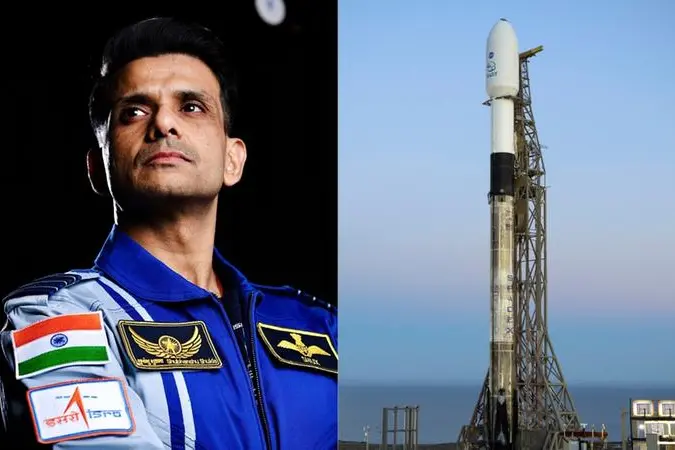
As the first Indian to visit the International Space Station (ISS) and only the second Indian in orbit after Rakesh Sharma in 1984, astronaut Shubhanshu Shukla made history on June 26, 2025, and India was proud to witness. However, if it weren’t for the prompt and forceful involvement of the Indian Space Research Organization (ISRO), his space voyage would have been nearly ruined.
The focal point of this tale is ISRO Chief Dr. V Narayanan, whose technical know-how and leadership guaranteed not only the mission’s ultimate success but also the crew’s safety.
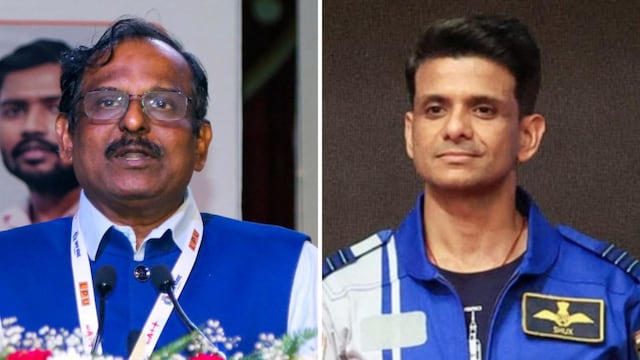
Credits: News18
The Crack That Almost Killed the Mission
Axiom Mission-4 was supposed to launch on June 11 but was abruptly canceled one day before takeoff. Speaking at the IEEE International Conference at Presidency University in Bengaluru, Dr. Narayanan described the drama that goes on behind the scenes.
“I was leading the team, and after thorough discussions, we decided not to accept the takeoff,” he stated. After careful examination, the ISRO team discovered a leak and then a crack in the Falcon 9 booster, which was supposed to send Shukla and the other three crew members into orbit.
Despite initial resistance from other stakeholders, ISRO refused to proceed, prioritizing crew safety over schedules. “My team was not confident about the rocket’s integrity and refused to participate,” Dr. Narayanan recalled.
SpaceX Confirms: ISRO Was Right
While ISRO’s caution was initially met with skepticism, the following day, SpaceX engineers confirmed the presence of a crack in the booster. Their validation reinforced the importance of ISRO’s intervention.
“It was a fantastic job of saving the mission,” Narayanan proudly stated. “Today, astronaut Shubhanshu Shukla and the entire mission are safe. India is second to none.”
ISRO’s insistence on rigorous checks showcased its rising stature as a reliable partner in international space collaborations.
Axiom-4: Science, Collaboration, and Legacy
Axiom Mission-4 (Ax-4), a partnership between Axiom Space, NASA, ISRO, and SpaceX, finally launched successfully from NASA’s Kennedy Space Center on June 26. The four-member crew embarked on a 14-day research-intensive mission aboard the ISS.
This mission wasn’t just historic for India—it was Axiom’s most science-driven journey to date, with over 60 experiments representing 31 countries. Areas of research included:
- Space agriculture (sprouting moong daal and methi)
- Muscle regeneration and microgravity-induced muscle loss
- Diabetes research (glucose regulation via the Suite Ride study)
- Tardigrade biology and survival of aquatic micro-organisms
- Human-computer interaction in microgravity
For India, the inclusion of indigenous experiments, such as testing the viability of native crops in space, added both scientific and emotional weight to the mission.

Shubhanshu Shukla: A National Icon Takes Flight
The voyage of Shubhanshu Shukla represents a new chapter in Indian space dreams. His arrival as the first Indian on board the ISS represents a significant advancement in India’s technological outreach and space diplomacy. His participation not only lays the way for future Indian astronauts but also deepens the relationship between ISRO and worldwide space organizations.
Shukla’s trip is a testament to India’s ambitions and skills in human spaceflight, ranging from carrying out cutting-edge research to representing India internationally.
India’s Growing Role in Global Space Affairs
More than just a scientific journey, the Ax-4 mission was a strong statement of India’s influence over international space governance and safety regulations. The fact that ISRO was able to spot and report a potentially disastrous defect shows how much power it has gained in the global space community.
“India is second to none,” as Dr. Narayanan so eloquently stated. India’s space program is not only catching up, but also leading the way, with projects like Gaganyaan in the works and fruitful collaborations being established.
In conclusion, the tale of Axiom-4 is about bravery, teamwork, and the growing power of Indian space science, not only about a successful space mission.